

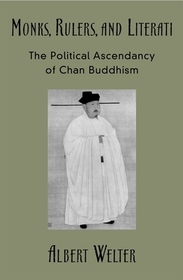
Monks, Rulers, and Literati
The Political Ascendancy of Chan Buddhism
- Publisher's listprice GBP 100.00
-
47 775 Ft (45 500 Ft + 5% VAT)
The price is estimated because at the time of ordering we do not know what conversion rates will apply to HUF / product currency when the book arrives. In case HUF is weaker, the price increases slightly, in case HUF is stronger, the price goes lower slightly.
- Discount 10% (cc. 4 778 Ft off)
- Discounted price 42 998 Ft (40 950 Ft + 5% VAT)
Subcribe now and take benefit of a favourable price.
Subscribe
47 775 Ft

Availability
printed on demand
Why don't you give exact delivery time?
Delivery time is estimated on our previous experiences. We give estimations only, because we order from outside Hungary, and the delivery time mainly depends on how quickly the publisher supplies the book. Faster or slower deliveries both happen, but we do our best to supply as quickly as possible.
Product details:
- Publisher OUP USA
- Date of Publication 23 February 2006
- ISBN 9780195175219
- Binding Hardback
- No. of pages334 pages
- Size 243x165x26 mm
- Weight 617 g
- Language English
- Illustrations 3 maps, 20 line drawings, tables 0
Categories
Short description:
The Chan (Zen in Japanese) school of Chinese Buddhism began when, in the seventh century, a small religious community gathered around a Buddhist monk named Hongren. Over the centuries, Chan Buddhism grew from an obscure movement to an officially recognized and eventually dominant form of Buddhism in China and throughout East Asia. In this book Albert Welter presents, for the first time in a comprehensive fashion in a Western work, the story of the rise of Chan, a story which has been obscured by myths about Zen. Zen apologists in the twentieth century, Welter argues, sold the world on the story of Zen as a transcendental spiritualism untainted by political and institutional involvements. In fact, Welter shows that the opposite is true: relationships between Chan monks and political rulers were crucial to Chan's success. The book concentrates on an important but neglected period of Chan history, the 10th and 11th centuries, when monks and rulers created the so-called Chan "golden age" and the classic principles of Chan identity.
MoreLong description:
The Chan (Zen in Japanese) school of Chinese Buddhism began when, in the seventh century, a small religious community gathered around a Buddhist monk named Hongren. Over the centuries, Chan Buddhism grew from an obscure movement to an officially recognized and eventually dominant form of Buddhism in China and throughout East Asia. In this book Albert Welter presents, for the first time in a comprehensive fashion in a Western work, the story of the rise of Chan, a story which has been obscured by myths about Zen. Zen apologists in the twentieth century, Welter argues, sold the world on the story of Zen as a transcendental spiritualism untainted by political and institutional involvements. In fact, Welter shows that the opposite is true: relationships between Chan monks and political rulers were crucial to Chan's success. The book concentrates on an important but neglected period of Chan history, the 10th and 11th centuries, when monks and rulers created the so-called Chan "golden age" and the classic principles of Chan identity.
Welter's Monks, Rulers, and Literati is a much needed and very readable work that presents a rich and multifaceted picture of the development of Chan and significantly advances our understanding of it. It is a must-read for every scholar interested in Chinese Buddhism. I will also be highly useful in graduate seminars and even in upper-level undergraduate courses.

