

- Publisher's listprice GBP 6.99
-
3 155 Ft (3 005 Ft + 5% VAT)
The price is estimated because at the time of ordering we do not know what conversion rates will apply to HUF / product currency when the book arrives. In case HUF is weaker, the price increases slightly, in case HUF is stronger, the price goes lower slightly.
- Discount 10% (cc. 315 Ft off)
- Discounted price 2 840 Ft (2 705 Ft + 5% VAT)
Subcribe now and take benefit of a favourable price.
Subscribe
3 155 Ft

Availability
Only to order.
Why don't you give exact delivery time?
Delivery time is estimated on our previous experiences. We give estimations only, because we order from outside Hungary, and the delivery time mainly depends on how quickly the publisher supplies the book. Faster or slower deliveries both happen, but we do our best to supply as quickly as possible.
Product details:
- Publisher OUP India
- Date of Publication 23 May 2013
- ISBN 9780198075417
- Binding Paperback
- No. of pages224 pages
- Size 195x122x18 mm
- Weight 238 g
- Language English 0
Categories
Short description:
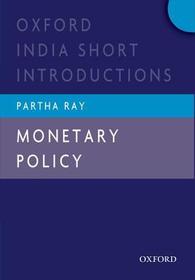
From a day-to-day watch on financial markets and indicators to keeping a tab on the nation's growth and inflation, monetary policy is a complex field which requires an active response from central banks. Providing the global and theoretical context of monetary policy, especially in light of the recent financial crisis, this Short Introduction analyses the evolution and practice of monetary policy in India from 1934 to present times.
MoreLong description:
The Oxford India Short Introductions are concise, stimulating, and accessible guides to different aspects of India. Combining authoritative analysis, new ideas, and diverse perspectives, they discuss subjects which are topical yet enduring, as also emerging areas of study and debate.
Monetary policy plays a pivotal role in shaping interest rates and controlling inflation. Turbulence in both during the recent global financial crisis and current sovereign debt crisis in Europe has accentuated the ever-growing interest in the role of monetary policy and the functioning of central banks. It is in this context that this Short Introduction analyses the evolution of Indian monetary policy over the historical timeline of 1934 to present times. Dividing this period into several epochs, the author explains how at various points the monetary policy was shaped by the need of hour, be it the policy of credit control to support planned development in the 1950s or the introduction of liquidity adjustment facility to meet the needs of the changing economy in the post-liberalization phase. He also shows how India's monetary policies and practices have helped it absorb the shocks of the financial crisis.
Table of Contents:
List of Tables
Figures, and Boxes
1. What is Monetary Policy?
2. The Early Years: 1934-50;
3. The Foundation Stage: 1951-68
4. Bank Nationalization and Credit Planning: 1969-85
5. Monetary Targeting: 1986-98
6. Multiple Indicator Approach and Liquidity Adjustment Facilities: 1998 Onwards
Epilogue
Annexure: RBI Governors
References
Index

