

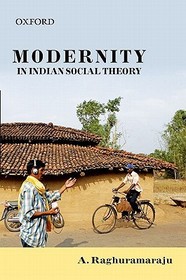
Modernity in Indian Social Theory
- Publisher's listprice GBP 23.00
-
10 384 Ft (9 890 Ft + 5% VAT)
The price is estimated because at the time of ordering we do not know what conversion rates will apply to HUF / product currency when the book arrives. In case HUF is weaker, the price increases slightly, in case HUF is stronger, the price goes lower slightly.
- Discount 10% (cc. 1 038 Ft off)
- Discounted price 9 346 Ft (8 901 Ft + 5% VAT)
Subcribe now and take benefit of a favourable price.
Subscribe
10 384 Ft

Availability
Only to order.
Why don't you give exact delivery time?
Delivery time is estimated on our previous experiences. We give estimations only, because we order from outside Hungary, and the delivery time mainly depends on how quickly the publisher supplies the book. Faster or slower deliveries both happen, but we do our best to supply as quickly as possible.
Product details:
- Publisher OUP India
- Date of Publication 3 February 2011
- ISBN 9780198070122
- Binding Hardback
- No. of pages188 pages
- Size 223x146x17 mm
- Weight 290 g
- Language English 0
Categories
Short description:
This book deals with a re-reading of the question and concept of modernity in Indian social theory and its application to understand contemporary Indian society and texts. It examines the work of several past and contemporary thinkers as well as issues like nationalism, secularism, notions of majority and minority, and lived Dalit experiences.
MoreLong description:
This volume revisits the question and concept of modernity in Indian social theory and how this reading could be used to understand contemporary Indian society and texts. It discusses the limitations surrounding Indian social theorists' discussion of Indian society. The book focuses on specific seminal accounts like that of Partha Chatterjee on Indian nationalism, Javeed Alam on the reading of Indian secularism, and Gopal Guru on the Dalit lived experience. Subsequent chapters critically examine the writings of key thinkers including Vivekananda, Aurobindo, Gandhi, and Ambedkar.
Illuminating and at times inspirational...This book is a model for how philosophy might build new bridges between traditions for real benefits. As our world shrinks, this model may well shed light on our common future. And the future looks bright.
Table of Contents:
Introduction: Theoretical Invariance and Social Variance
Nationalism
Secularism
Internal Criticism
Reading Rajas and Tamas
Lived Dalit Experience
Modernity and Art, India and Textile
Conclusion

