

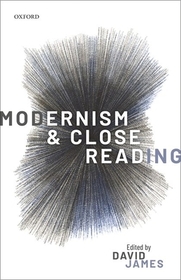
Modernism and Close Reading
- Publisher's listprice GBP 96.00
-
43 344 Ft (41 280 Ft + 5% VAT)
The price is estimated because at the time of ordering we do not know what conversion rates will apply to HUF / product currency when the book arrives. In case HUF is weaker, the price increases slightly, in case HUF is stronger, the price goes lower slightly.
- Discount 10% (cc. 4 334 Ft off)
- Discounted price 39 010 Ft (37 152 Ft + 5% VAT)
Subcribe now and take benefit of a favourable price.
Subscribe
43 344 Ft

Availability
Estimated delivery time: In stock at the publisher, but not at Prospero's office. Delivery time approx. 3-5 weeks.
Not in stock at Prospero.
Why don't you give exact delivery time?
Delivery time is estimated on our previous experiences. We give estimations only, because we order from outside Hungary, and the delivery time mainly depends on how quickly the publisher supplies the book. Faster or slower deliveries both happen, but we do our best to supply as quickly as possible.
Product details:
- Publisher OUP Oxford
- Date of Publication 29 April 2020
- ISBN 9780198749967
- Binding Hardback
- No. of pages260 pages
- Size 240x160x25 mm
- Weight 546 g
- Language English 40
Categories
Short description:
The book offers new methodological and interpretive avenues for reconceptualising modernism's longstanding relationship to close reading.
MoreLong description:
The kinship between modernism and close reading has long between taken for granted. But for that reason, it has also gone unexamined. As the archives, timeframes, and cultural contexts of global modernist studies proliferate, the field's rapport with close reading no longer appears self-evident or guaranteed--even though for countless students studying literary modernism still invariably means studying close reading. This authoritative collection of essays illuminates close reading's conceptual, institutional, and pedagogical genealogies as a means of examining its enduring potential. David James brings together a cast of world-renowned scholars to offer an account of some of the things we might otherwise know, and need to know, about the history of modernist theories of reading, before then providing a sense of how the futures for critical reading look different in light of the multiple ways in which modernism has been close read.
Modernism and Close Reading responds to a contemporary climate of unprecedented reconstitution for the field: it takes stock of close reading's methodological possibilities in the wake of modernist studies' geographical, literary-historical, and interdisciplinary expansions; and it shows how the political, ethical, and aesthetic consequences of attending to matters of form complicate ideological preconceptions about the practice of formalism itself. By reassessing the intellectual commitments and institutional conditions that have shaped modernism in criticism as well as in the classroom, we are able to ask new questions about close reading that resonate across literary and cultural studies. Invigorating that critical venture, this volume enriches our vocabulary for addressing close reading's perpetual development and diversification.
Modernism and Close Reading is a valuable addition to our current reading method debate. It comes at a time when a reassessment of the past is crucial if our discussions are to be productive and historically grounded. The book counters the dismissal of close reading as a relic of the modernist past and shows this method to be essential to the future of literary studies.
Table of Contents:
Introduction
PART I: HISTORIES OF MODERNISM AND CLOSE READING
Modernist Close Reading
Close Reading as Performance
Poetry Explication: The Making of a Method
Slow Revelations: James Joyce and the Rhetorics of Reading
When Did Close Reading Acquire a Bad Name?
PART II: FUTURES FOR CLOSE READING MODERNISM
Queer Surrealism
Nabokov and the Privilege of Style
Bird Girls: Modernism and Sexual Ethics in Contemporary Irish Fiction
Tom McCarthy's Modernism: Close Encounters of a Pleasurable Kind
Experiencing the Modernist Storymind: A Cognitive Reading of Narrative Space
Thinking Small: Ecologies of Close Reading

