

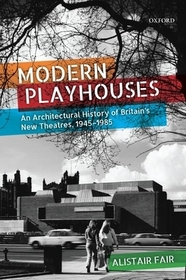
Modern Playhouses
An Architectural History of Britain's New Theatres, 1945-1985
- Publisher's listprice GBP 39.99
-
18 055 Ft (17 195 Ft + 5% VAT)
The price is estimated because at the time of ordering we do not know what conversion rates will apply to HUF / product currency when the book arrives. In case HUF is weaker, the price increases slightly, in case HUF is stronger, the price goes lower slightly.
- Discount 10% (cc. 1 806 Ft off)
- Discounted price 16 249 Ft (15 476 Ft + 5% VAT)
Subcribe now and take benefit of a favourable price.
Subscribe
18 055 Ft

Availability
Estimated delivery time: In stock at the publisher, but not at Prospero's office. Delivery time approx. 3-5 weeks.
Not in stock at Prospero.
Why don't you give exact delivery time?
Delivery time is estimated on our previous experiences. We give estimations only, because we order from outside Hungary, and the delivery time mainly depends on how quickly the publisher supplies the book. Faster or slower deliveries both happen, but we do our best to supply as quickly as possible.
Product details:
- Publisher OUP Oxford
- Date of Publication 27 July 2020
- ISBN 9780198864080
- Binding Paperback
- No. of pages320 pages
- Size 155x235x18 mm
- Weight 480 g
- Language English
- Illustrations 60 black and white figures/illustrations 7
Categories
Short description:
The first detailed study of the major programme of theatre-building in Britain between the 1950s and the 1980s, Modern Playhouses draws on a vast range of archival material to present the history of post-war theatre buildings as a history of ideas relating not only to performance but also to culture, citizenship, and the modern city.
MoreLong description:
Modern Playhouses is the first detailed study of the major programme of theatre-building which took place in Britain between the 1950s and the 1980s. Drawing on a vast range of archival material - much of which had never previously been studied by historians - it sets architecture in a wide social and cultural context, presenting the history of post-war theatre buildings as a history of ideas relating not only to performance but also to culture, citizenship, and the modern city.
During this period, more than sixty major new theatres were constructed in locations from Plymouth to Inverness, Aberystwyth to Ipswich. The most prominent example was the National Theatre in London, but the National was only the tip of the iceberg. Supported in many cases by public subsidies, these buildings represented a new kind of theatre, conceived as a public service. Theatre was ascribed a transformative role, serving as a form of 'productive' recreation at a time of increasing affluence and leisure. New theatres also contributed to debates about civic pride, urbanity, and community. Ultimately, theatre could be understood as a vehicle for the creation of modern citizens in a consciously modernizing Britain.
Yet while recognizing, as contemporaries did, that the new theatres of the post war decades represented change, Modern Playhouses also asks how radically different these buildings really were, and what their 'mainstream' architecture reveals of the history of modern British architecture, and of post-war Britain.
Review from previous edition a highly nuanced account of the welfare state and its architecture a substantial addition to a growing scholarship concerned with the impact of affluence, and perceived affluence, on shaping post-war government policy
Table of Contents:
Introduction: 'The Pattern is Now Quite Different'
'An Instrument of Policy and Something Socially Desirable': Public Funding and Theatre
'Housing the Arts': Funding Capital Projects
Towards a New Theatre Architecture, 1945-1960
'The Second Positive Stage': Modern Public Buildings, c.1958-1971
'A New Image of the Town Centre': Theatres, Civic Pride, and Urbanity
'The Modern Concept of a Community Theatre': The Social Centre
'At the End of a Boom'? Frugality and Contextualism, c.1968-1985
'Theatre of the Future': Rethinking the Auditorium
'The Most Revolutionary Thing?' Modern Proscenium-arch & End-stage Auditoria
Escaping From Boarded Concrete and Modern Finishes'? Impermanency, Mobility, Rehabilitation - And Emulation
Conclusions: 'Out Of Its Sick Bed'

