

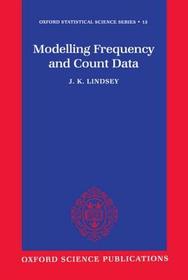
Modelling Frequency and Count Data
Series: Oxford Statistical Science Series; 15;
- Publisher's listprice GBP 79.00
-
37 742 Ft (35 945 Ft + 5% VAT)
The price is estimated because at the time of ordering we do not know what conversion rates will apply to HUF / product currency when the book arrives. In case HUF is weaker, the price increases slightly, in case HUF is stronger, the price goes lower slightly.
- Discount 10% (cc. 3 774 Ft off)
- Discounted price 33 968 Ft (32 351 Ft + 5% VAT)
Subcribe now and take benefit of a favourable price.
Subscribe
37 742 Ft

Availability
printed on demand
Why don't you give exact delivery time?
Delivery time is estimated on our previous experiences. We give estimations only, because we order from outside Hungary, and the delivery time mainly depends on how quickly the publisher supplies the book. Faster or slower deliveries both happen, but we do our best to supply as quickly as possible.
Product details:
- Publisher Clarendon Press
- Date of Publication 27 April 1995
- Number of Volumes laminated boards
- ISBN 9780198523314
- Binding Hardback
- No. of pages300 pages
- Size 242x162x22 mm
- Weight 607 g
- Language English
- Illustrations line figures, tables 0
Categories
Short description:
Lindsey presents a complete range of material on this subject which can be immediately used with the major statistical packages. The important distinctions between independent and dependent events - frequencies and counts - structures the book. Many of the important areas of modern statistics from generalized linear models to survival analysis are demonstrated to be special cases of categorical data analysis.
MoreLong description:
Categorical data analysis is a special area of generalised linear models, which has become the most important area of statistical applications in many disciplines, from medicine to social sciences. This text presents the standard models and many newly developed ones in a language which can be immediately applied in many modern statistical packages such as GLIM, GENSTAT, S-Plus, as well as SAS and LISP-STAT. The book is structure around the distinction between independent events occurring to different individuals, resulting in frequencies, and repeated events occurring to the same individuals, yielding counts. The book demonstates that much of modern statistics can be seen as special cases of categorical data models; both generalized linear models and proportional hazards models can be fitted as log linear models. More specialized topics such as Markov chains, overdispersion and random effects, are also covered.
MoreTable of Contents:
One-way frequency tables
Larger tables
Regression models
Ordinal variables
Zero frequencies
Fitting distributions
Counting processes
Markov chains
Structured transition matrices
Overdispersion and cluster models
GLIM macros
Bibliography
Index

