

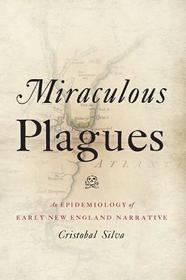
Miraculous Plagues
An Epidemiology of Early New England Narrative
- Publisher's listprice GBP 33.99
-
15 346 Ft (14 615 Ft + 5% VAT)
The price is estimated because at the time of ordering we do not know what conversion rates will apply to HUF / product currency when the book arrives. In case HUF is weaker, the price increases slightly, in case HUF is stronger, the price goes lower slightly.
- Discount 10% (cc. 1 535 Ft off)
- Discounted price 13 811 Ft (13 154 Ft + 5% VAT)
Subcribe now and take benefit of a favourable price.
Subscribe
15 346 Ft

Availability
printed on demand
Why don't you give exact delivery time?
Delivery time is estimated on our previous experiences. We give estimations only, because we order from outside Hungary, and the delivery time mainly depends on how quickly the publisher supplies the book. Faster or slower deliveries both happen, but we do our best to supply as quickly as possible.
Product details:
- Publisher OUP USA
- Date of Publication 12 May 2016
- ISBN 9780190272401
- Binding Paperback
- No. of pages256 pages
- Size 155x231x15 mm
- Weight 363 g
- Language English 0
Categories
Short description:
Miraculous Plagues examines the forms and conventions of colonial epidemiology in order to re-imagine New England's early literary history as a function of the narrative, legal, and theological responses to regional and generational patterns of illness in the seventeenth- and early eighteenth centuries.
MoreLong description:
In the summer of 1629, John Winthrop described a series of epidemics that devastated Native American populations along the eastern seaboard of New England as a "miraculous plague." Winthrop was struck by the providential nature of these waves of disease, which contributed neatly to the settlers' justifications for colonial expansion. Taking Winthrop's phrase as its cornerstone, Miraculous Plagues reimagines New England's literary history by tracing seventeenth- and early eighteenth-century epidemics alongside events including early migration, the Antinomian controversy, the evolution of the halfway covenant and jeremiad, and Boston's 1721 inoculation controversy.
Moving beyond familiar histories of New World epidemics (often referred to as the "virgin soil" model), Cristobal Silva identifies epidemiology as a generic category with specialized forms and conventions. Epidemiology functions as both subject and method in Silva's argument, as he details narratives that represent modes of infection, population distribution, and immunity. He considers how regional and generational patterns of illness affected the perception of communal identity, and he analyzes the translation of epidemic events into narrative and generic terms, providing scholars a new way to conceptualize the relationship between immunology and ideology.
Closing with a discussion of the HIV/AIDS epidemic, Miraculous Plagues underscores the portability of its insights into the geopolitics of medicine. Just as epidemiology aided in transforming colonial America, it continues to influence questions of geography, community, and identity that are bound up in global health practices today.
Table of Contents:
Acknowledgments
Introduction
Chapter 1: New England Epidemiology
Chapter 2: Vectors of Dissent
Chapter 3: Puritan Immunology
Chapter 4: Technologies of Inoculation
Afterword
Works Cited
Index

