

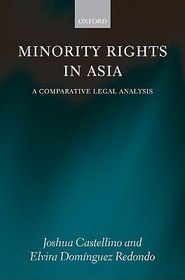
Minority Rights in Asia
A Comparative Legal Analysis
- Publisher's listprice GBP 105.00
-
47 407 Ft (45 150 Ft + 5% VAT)
The price is estimated because at the time of ordering we do not know what conversion rates will apply to HUF / product currency when the book arrives. In case HUF is weaker, the price increases slightly, in case HUF is stronger, the price goes lower slightly.
- Discount 10% (cc. 4 740 Ft off)
- Discounted price 42 667 Ft (40 635 Ft + 5% VAT)
Subcribe now and take benefit of a favourable price.
Subscribe
47 407 Ft

Availability
printed on demand
Why don't you give exact delivery time?
Delivery time is estimated on our previous experiences. We give estimations only, because we order from outside Hungary, and the delivery time mainly depends on how quickly the publisher supplies the book. Faster or slower deliveries both happen, but we do our best to supply as quickly as possible.
Product details:
- Publisher OUP Oxford
- Date of Publication 20 April 2006
- ISBN 9780199296057
- Binding Hardback
- No. of pages312 pages
- Size 242x163x23 mm
- Weight 633 g
- Language English 50
Categories
Short description:
Minority rights law has been an important axis for the evolution of international law itself. While much has been written about minority rights regimes in Europe, there is very little information available with regards to Asian experiences. Countries in Asia, with their diverse populations, are struggling with constructing legal systems that will deliver on the promise of equal rights to all its citizens. This book evaluates these attempts in four Asian states: India, China, Malaysia and Singapore by examining the theory and practice of minority rights law in these vastly different settings.
MoreLong description:
The absence of a regional system of human rights protection for Asia, and the ambivalence of some Asian states towards existing human rights regimes often results in a lack of awareness of the plight of minorities in these states. The existing human rights literature on Asia tends to focus on the debate of cultural relativism. On the other hand, minority rights literature largely ignores Asia. This book tackles this lacuna by undertaking an analysis of the minority rights legal regimes in India, China, Malaysia and Singapore, while also locating this discussion in the context of a wider debate on human rights in Asia.
India and China, the world's most populous states, face similar problems vis-à-vis minorities, yet tackle these using starkly different techniques. Malaysia and Singapore, vocal in their articulation of 'Asian Values', have taken opposing stances over minority rights. Malaysia has sought to establish Malay hegemony using minority rights tools in favour of the majority, while Singapore deliberately adopted a doctrine of meritocracy, nonetheless emphasising ethnic fault-lines within its population. Together the four states reflect not only the complex layers of culture and identity within Asian states, but also the vastly different political systems and contrasting conceptions of the role of law in the continent.
Through its examination of minority rights theory and its application in specific cases, this book provides a useful comparative model for the assessment of other states within Asia, thereby taking an important first step towards understanding the situation of minorities within the entire continent.
Table of Contents:
Introduction
Asian States, International Human Rights Law, and Minority Rights
Minority Rights in India
Minority Rights in China
Minority Rights in Malaysia
Minority Rights in Singapore
Conclusion

