

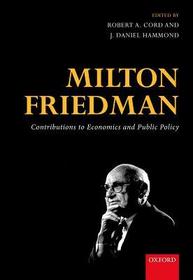
Milton Friedman
Contributions to Economics and Public Policy
- Publisher's listprice GBP 187.50
-
84 656 Ft (80 625 Ft + 5% VAT)
The price is estimated because at the time of ordering we do not know what conversion rates will apply to HUF / product currency when the book arrives. In case HUF is weaker, the price increases slightly, in case HUF is stronger, the price goes lower slightly.
- Discount 10% (cc. 8 465 Ft off)
- Discounted price 76 191 Ft (72 563 Ft + 5% VAT)
Subcribe now and take benefit of a favourable price.
Subscribe
84 656 Ft

Availability
printed on demand
Why don't you give exact delivery time?
Delivery time is estimated on our previous experiences. We give estimations only, because we order from outside Hungary, and the delivery time mainly depends on how quickly the publisher supplies the book. Faster or slower deliveries both happen, but we do our best to supply as quickly as possible.
Product details:
- Publisher OUP Oxford
- Date of Publication 16 June 2016
- ISBN 9780198704324
- Binding Hardback
- No. of pages888 pages
- Size 249x184x51 mm
- Weight 1630 g
- Language English
- Illustrations Figures 0
Categories
Short description:
This book brings together experts on Milton Friedman's life and thought. They draw on their experiences to present original insights into Friedman's method of working, his ability to communicate ideas to the general public, his influence on other economists, and the continuing role that his ideas have had during the present economic crisis.
MoreLong description:
Milton Friedman is widely regarded as one of the most influential economists of the twentieth century. Although he made many important contributions to both economic theory and policy - most clearly demonstrated by his development of and support for monetarism - he was also active in various spheres of public policy, where he more often than not pursued his championing of the free market and liberty.
This volume assesses the importance of the full range of Friedman's ideas, from his work on methodology in economics, his highly innovative consumption theory, and his extensive research on monetary economics, to his views on contentious social and political issues such as education, conscription, and drugs. It also presents personal recollections of Friedman by some of those who knew him, both as students and colleagues, and offers new evidence on Friedman's interactions with other noted economists, including George Stigler and Lionel Robbins.
The volume provides readers with an up to date account of Friedman's work and continuing influence and will help to inform and stimulate further research across a variety of areas, including macroeconomics, the history of economic thought, as well as the development and different uses of public policy. With contributions from a stellar cast, this book will be invaluable to academics and students alike.
This huge feast of a book offers a choice of 40 servings presented over a range of five courses on one of the twentieth centurys economic giants.
Table of Contents:
Introduction
Part 1. Reflections on Friedman
Milton Friedman as Teacher and Scholar
Milton Friedman: An Appreciation
Remembering Milton Friedman
The Place of Milton Friedman in the History of Economic Thought
Milton Friedman's Public Life After Retirement, 1976-1988
Part 2. Monetary Theory and Policy
Milton Friedman as an Empirical Modeler
Milton Friedman and US Monetary History
Reflections on Friedman's Macroeconomics
Reflections on Milton Friedman, the South during the Civil War, and Current Events
Milton Friedman's Monetary Economics: Theory and Empirics
Friedman, Chicago, and Monetary Rules
Why and How Should a Monetary Economy be Stabilised? The Forgotten Lessons of Milton Friedman
Friedman's Characterization of the Natural Rate of Unemployment
What Would Milton Friedman Have Thought of Market Monetarism?
Friedman and Divisia Monetary Measures
Arthur Burns and Milton Friedman: Why did the Master (Burns) and the Disciple (Friedman) Understand Inflation in a Diametrically Opposed Way?
Milton Friedman and the Federal Reserve Chairs in the 1970s
Monetary Targeting in Australia: Problems of Control and Prediction
Milton Friedman, the Quantity Theory and Hyperinflation in Russia
Part 3. Consumption Theory, Fiscal Policy, and Public Policy
Friedman's Theory of Income and Consumption, Then and Now
Milton Friedman's Contributions to Fiscal Economics
Friedman and the Income Effects of Financing Government Deficits
Milton Friedman and the Finance of Higher Education
Milton Friedman, Drug Legalization, and Public Policy
Milton Friedman and Occupational Licensing
Slaves or Mercenaries? Milton Friedman and the Institution of the All-Volunteer Military
Straining the Social Bond: Government Policy vs. Social Custom in Capitalism and Freedom
Part 4. Methodology
On Reading and Misreading Friedman's 1953 Methodology Essay
Milton Friedman's Methodology, Macroeconomics, and the Great Recession
Milton Friedman: A Bayesian?
Friedman and the Cowles Commission
Part 5. Friedman and Other Economists
Milton Friedman: Constructing an Anti-Keynes
The Economics and Political Economy of Milton Friedman: An Old Keynesian Critique
Friedman and his Collegial Detractors
Milton Friedman and George J. Stigler: Early Interactions and Connections
Friedman and the Austrians
Milton Friedman, James Buchanan and Constitutional Political Economy
Friedman and Robbins
Friedman and Viner
Economists as forecasters: Milton Friedman and Paul Samuelson, 1970-1974

