

- Publisher's listprice GBP 9.99
-
4 510 Ft (4 295 Ft + 5% VAT)
The price is estimated because at the time of ordering we do not know what conversion rates will apply to HUF / product currency when the book arrives. In case HUF is weaker, the price increases slightly, in case HUF is stronger, the price goes lower slightly.
- Discount % (cc. 0 Ft off)
- Discounted price 0 Ft (0 Ft + 5% VAT)
Subcribe now and take benefit of a favourable price.
Subscribe
4 510 Ft

Availability
Out of print
Why don't you give exact delivery time?
Delivery time is estimated on our previous experiences. We give estimations only, because we order from outside Hungary, and the delivery time mainly depends on how quickly the publisher supplies the book. Faster or slower deliveries both happen, but we do our best to supply as quickly as possible.
Product details:
- Publisher OUP USA
- Date of Publication 23 February 2017
- ISBN 9780199340132
- Binding Paperback
- No. of pages144 pages
- Size 112x168x12 mm
- Weight 136 g
- Language English 0
Categories
Short description:
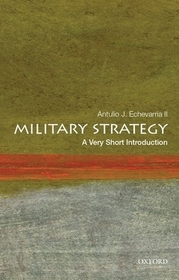
This Very Short Introduction adapts Clausewitz's framework to highlight the dynamic relationship between the main elements of strategy: purpose, method, and means. Drawing on historical examples, Echevarria discusses the major types of military strategy and how emerging technologies are affecting them.
MoreLong description:
Since ancient times, poets, historians, and philosophers have contemplated warlords' exploits in battle and praised their ability to lead armies toward victory as the "art of the general." Today, this quality is designated military strategy. Military strategy plays a vital role in every conflict, because, as the United States' involvement in the Vietnam conflict showed, when the overarching strategy is weak it is possible to win every battle but still lose a war.
Taking inspiration from the greatest military theoreticians of history, such as Sun Tzu, Niccolò Machiavelli, and Carl von Clausewitz, this Very Short Introduction highlights the dynamic relationship between the principal components of strategy: purpose, method, and means. Drawing on paradigmatic examples, from Hannibal's war against Rome to Napoleon's victory at Austerlitz, from the Allies' campaign to overwhelm Hitler's fortress to the terror attacks of September 11, Antulio J. Echevarria II vividly illustrates the factors contributing to the success or failure of military strategy.
Echevarria describes the major types of military strategy and their advantages and disadvantages: annihilation and dislocation; attrition and exhaustion; deterrence and coercion; terror and terrorism; targeted killing; and cyber power. He also explores the emerging nano- and bio-genetic technologies and explains how they are affecting today's military strategy. Clear and engaging, this book shows that military strategy is essential for understanding major events of the past and becomes even more critical today, in a world increasingly threatened by weapons of mass destruction, terrorist attacks, and new dimensions of conflict, such as cyberwar and space.
Table of Contents:
Prologue
Chapter 1: What is Military Strategy?
Chapter 2: Annihilation and Dislocation
Chapter 3: Attrition and Exhaustion
Chapter 4: Deterrence and Coercion
Chapter 5: Terror and Terrorism
Chapter 6: Decapitation and Targeted Killing
Chapter 7: Cyber Power and Military Strategy
Epilogue
References
Further Reading
Index

