

- Publisher's listprice GBP 9.99
-
4 772 Ft (4 545 Ft + 5% VAT)
The price is estimated because at the time of ordering we do not know what conversion rates will apply to HUF / product currency when the book arrives. In case HUF is weaker, the price increases slightly, in case HUF is stronger, the price goes lower slightly.
- Discount 10% (cc. 477 Ft off)
- Discounted price 4 295 Ft (4 091 Ft + 5% VAT)
Subcribe now and take benefit of a favourable price.
Subscribe
4 772 Ft

Availability
Permanently out of stock
Why don't you give exact delivery time?
Delivery time is estimated on our previous experiences. We give estimations only, because we order from outside Hungary, and the delivery time mainly depends on how quickly the publisher supplies the book. Faster or slower deliveries both happen, but we do our best to supply as quickly as possible.
Product details:
- Publisher OUP USA
- Date of Publication 27 October 2016
- ISBN 9780199303496
- Binding Paperback
- No. of pages160 pages
- Size 170x107x10 mm
- Weight 136 g
- Language English
- Illustrations 10 0
Categories
Short description:
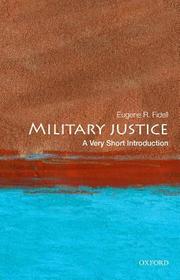
This book presents an accessible and honest assessment of the strengths and weaknesses of military justice around the world, with particular emphasis on the US, UK, and Canada.
MoreLong description:
You can't handle the truth. These iconic words, bellowed by Jack Nicholson as Colonel Jessup in the 1992 movie A Few Good Men, became an emblem of the conflict between honor and truth that the collective imagination often considers the quintessence of military justice. The military is the rare part of contemporary society that enjoys the privilege of policing its own members' behavior, with special courts and a separate body of rules. Whether one is for or against this system, military trials are fascinating and little understood. This book opens a window on the military judicial system, offering an accessible and balanced assessment of the strengths and weaknesses of military legal regimes around the world. It illuminates US military justice through a comparison with civilian and foreign models for the administration of justice, with a particular emphasis on the UK and Canadian military justice systems.
Drawing on his experience as a serving officer, private practitioner, and law professor, Eugene R. Fidell presents a hard-hitting tour of the field, exploring military justice trends across different countries and compliance (or lack thereof) with contemporary human rights standards.
He digs into critical issues such as the response to sexual assault in the armed forces, the challenges of protecting judicial independence, and the effect of social media and modern technology on age-old traditions of military discipline. A rich series of case studies, ranging from examples of misconduct, such as the devastating Abu Ghraib photos, to political tangles, such as the Guantánamo military commissions, throw light on the high profile and occasionally obscure circumstances that emerge from today's military operations around the world. As Fidell's account shows, by understanding the mechanism of military justice we can better comprehend the political values of a country.
Table of Contents:
List of Illustrations
Acknowledgments
Preface
Introduction Separate Rules for a Separate Society
Chapter 1 Military Command and Military Discipline
Chapter 2 The Arc of Civilianization
Chapter 3 Who is Subject to Trial by Court-Martial?
Chapter 4 The Substantive Reach of Court-Martial Jurisdiction
Chapter 5 Command Influence, Lawful and Unlawful
Chapter 6 Conduct Unbecoming and All That
Chapter 7 The Military Judiciary
Chapter 8 Military Lawyering
Chapter 9 Military Justice in the Field
Chapter 10 What about Guantánamo?
Chapter 11 Peering Ahead
Glossary
References
Further Reading
Websites
About the Author
Index

