

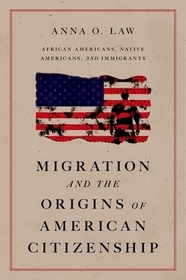
Migration and the Origins of American Citizenship
African Americans, Native Americans, and Immigrants
- Publisher's listprice GBP 19.99
-
9 025 Ft (8 595 Ft + 5% VAT)
The price is estimated because at the time of ordering we do not know what conversion rates will apply to HUF / product currency when the book arrives. In case HUF is weaker, the price increases slightly, in case HUF is stronger, the price goes lower slightly.
- Discount 10% (cc. 903 Ft off)
- Discounted price 8 122 Ft (7 736 Ft + 5% VAT)
Subcribe now and take benefit of a favourable price.
Subscribe
9 025 Ft

Availability
Estimated delivery time: In stock at the publisher, but not at Prospero's office. Delivery time approx. 3-5 weeks.
Not in stock at Prospero.
Why don't you give exact delivery time?
Delivery time is estimated on our previous experiences. We give estimations only, because we order from outside Hungary, and the delivery time mainly depends on how quickly the publisher supplies the book. Faster or slower deliveries both happen, but we do our best to supply as quickly as possible.
Product details:
- Publisher OUP USA
- Date of Publication 5 May 2026
- ISBN 9780197660096
- Binding Paperback
- No. of pages304 pages
- Size 226x150x22 mm
- Weight 340 g
- Language English 684
Categories
Short description:
This book traces the logics of slavery and settler colonialism in early US legal rulings and public policy about migration and citizenship. It presents the constitutional development of immigration law from the British colonies to the late nineteenth century, explaining the shifting balance of power between the state and federal governments.
MoreLong description:
Since the late nineteenth century, the US federal government has enjoyed exclusive authority to decide whether someone has the ability to enter and stay in US territory. But freedom of movement was not guaranteed in the British colonies or early US. By contrast, voluntary migrants were met with strict laws and policies created by colonies and states, which denied free mobility and settlement in their territories to unwanted populations.
Migration and the Origins of American Citizenship presents a story of constitutional development that traces the confluence of the logics of slavery and settler colonialism in early legal rulings and public policy about migration and citizenship. The book examines the division of labor between the national and state governments that endured for over a century, reasons why that arrangement changed in the late nineteenth century, and what the transformation meant for people subject to those regimes of control. Drawing into one study the migration policy histories of groups of people that are usually studied separately, and combining the methodologies of political science, history, and law, Anna O. Law reveals the unmistakable effects of slavery and Native American dispossession in modern US immigration policy.
The best works of history and political analysis show us that what was once invisible or taken for granted has had a history and a structure. Anna O. Law explains how American political development shaped the rules of migration. This book is comprehensive, illuminating, up to date in numerous fields - and couldn't be more timely. By defining migration to include enslaved and indigenous people, she innovates in U.S. history and in American Political Development.
Table of Contents:
Introduction
Sifting Migrants
Belonging
Migration and Citizenship at the Founding
Regulating International Borders
Regulating Interstate Borders
Formal Citizenship Defined
Historical Antecedents and Legal Precedents
Epilogue: Continuity, Change, and Constitutional Memory

