

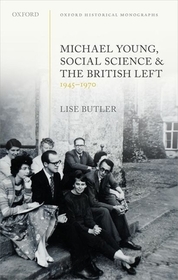
Michael Young, Social Science, and the British Left, 1945-1970
Series: Oxford Historical Monographs;
- Publisher's listprice GBP 89.00
-
40 183 Ft (38 270 Ft + 5% VAT)
The price is estimated because at the time of ordering we do not know what conversion rates will apply to HUF / product currency when the book arrives. In case HUF is weaker, the price increases slightly, in case HUF is stronger, the price goes lower slightly.
- Discount 10% (cc. 4 018 Ft off)
- Discounted price 36 165 Ft (34 443 Ft + 5% VAT)
Subcribe now and take benefit of a favourable price.
Subscribe
40 183 Ft

Availability
printed on demand
Why don't you give exact delivery time?
Delivery time is estimated on our previous experiences. We give estimations only, because we order from outside Hungary, and the delivery time mainly depends on how quickly the publisher supplies the book. Faster or slower deliveries both happen, but we do our best to supply as quickly as possible.
Product details:
- Publisher OUP Oxford
- Date of Publication 3 September 2020
- ISBN 9780198862895
- Binding Hardback
- No. of pages278 pages
- Size 224x147x22 mm
- Weight 494 g
- Language English 18
Categories
Short description:
This book examines the relationship between social science and public policy in left-wing politics. It focuses on the time period between the end of the Second World War and the end of the first Wilson government through the figure of the policy maker, sociologist and social innovator Michael Young.
MoreLong description:
In post-war Britain, left-wing policy maker and sociologist Michael Young played a major role in shaping British intellectual, political, and cultural life, using his study of the social sciences to inform his political thought.
In the mid-twentieth century the social sciences significantly expanded, and played a major role in shaping British intellectual, political and cultural life. Central to this intellectual shift was the left-wing policy maker and sociologist Michael Young. As a Labour Party policy maker in the 1940s, Young was a key architect of the Party's 1945 election manifesto, 'Let Us Face the Future'. He became a sociologist in the 1950s, publishing a classic study of the East London working class, Family and Kinship in East London with Peter Willmott in 1957, which he followed up with a dystopian satire, The Rise of the Meritocracy, about a future society in which social status was determined entirely by intelligence. Young was also a prolific social innovator, founding or inspiring dozens of organisations, including the Institute of Community Studies, the Consumers' Association, Which?magazine, the Social Science Research Council and the Open University. Moving between politics, social science, and activism, Young believed that disciplines like sociology, psychology and anthropology could help policy makers and politicians understand human nature, which in turn could help them to build better political and social institutions.
This book examines the relationship between social science and public policy in left-wing politics between the end of the Second World War and the end of the first Wilson government through the figure of Michael Young. Drawing on Young's prolific writings, and his intellectual and political networks, it argues that he and other social scientists and policy makers drew on contemporary ideas from the social sciences to challenge key Labour values, like full employment and nationalisation, and to argue that the Labour Party should put more emphasis on relationships, family, and community. Showing that the social sciences were embedded in the project of social democratic governance in post-war Britain, it argues that historians and scholars should take their role in British politics and political thought seriously
What a pleasure it is to read a book that is both a serious work of history and a primer for contemporary politics
Table of Contents:
Acknowledgements
Introduction
'We were all very sick and very stupid': the Conference on the Psychological and Sociological Problems of Modern Socialism and the politics of the group
'Bigness is the Enemy of Humanity': Political and Economic Planning, social science, and public policy, 1945 to 1950
'For Richer, For Poorer': Family policy and women, 1950-52
The Institute of Community Studies, 1953-58
From kinship to consumerism: Coming to terms with the middle class, 1958-1963
Facing the future: Social science in the first Wilson government, 1964-70
Conclusion
Bibliography
Index

