

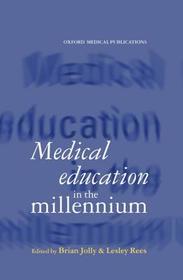
Medical Education in the Millennium
- Publisher's listprice GBP 110.00
-
49 665 Ft (47 300 Ft + 5% VAT)
The price is estimated because at the time of ordering we do not know what conversion rates will apply to HUF / product currency when the book arrives. In case HUF is weaker, the price increases slightly, in case HUF is stronger, the price goes lower slightly.
- Discount 10% (cc. 4 967 Ft off)
- Discounted price 44 699 Ft (42 570 Ft + 5% VAT)
Subcribe now and take benefit of a favourable price.
Subscribe
49 665 Ft

Availability
printed on demand
Why don't you give exact delivery time?
Delivery time is estimated on our previous experiences. We give estimations only, because we order from outside Hungary, and the delivery time mainly depends on how quickly the publisher supplies the book. Faster or slower deliveries both happen, but we do our best to supply as quickly as possible.
Product details:
- Publisher OUP Oxford
- Date of Publication 19 February 1998
- Number of Volumes laminated boards
- ISBN 9780192623997
- Binding Hardback
- No. of pages278 pages
- Size 248x172x20 mm
- Weight 643 g
- Language English
- Illustrations line figures 0
Categories
Short description:
As the 21st century approaches, what will be the roles and responsibilities of a doctor in the next century and how can we prepare young doctors for the future in a world which is rapidly changing? Medical education has entered a new era at all levels, led the way by changes in the undergraduate curricula as Medical educators are asking what change is necessary to prepare future physicians for practice in the 21st century. This book charts the new developments at the prequalification stage of medical training with specific examples of successful models and ideas for basic clinical training. It is an invaluable reference and guide for all those interested in medical education.
MoreLong description:
As the 21st century approaches, what will be the roles and responsibilities of a doctor in the next century and how can we prepare young doctors for the future in a world which is rapidly changing? Medical education has entered a new era at all levels, led the way by changes in the undergraduate curricula, and medical educators are asking what change is necessary to prepare future physicians for practice in the 21st century. This book charts recent developments in medical education that are withstanding the test of time and establishes a baseline for development in the next century. It deals with many important issuesin medical education covering the new developments at the prequalification stage of medical training. Specific examples of successful models and ideas for basic clinical training are included, and there are chapters on curriculum design, use of the internet, assessment, and clinical teaching and aims for the year 2000. Written by current leaders and researchers in the field, it is an invaluable reference and guide for all those interested in medical education.
...the authors have succeeded in providing a constructive review of some key aspects of medical education that can serve as the building blocks for curriculum planning and evaluation in the 21st century.
Table of Contents:
Aims of the Curriculum
Education for Health Needs in 2000 and Beyond
Curriculum Design
Charting the Course: Designing a curriculum
Curriculum Design, Case Studies: recent curriculum designs
Curriculum Design, The Patient's Perspective
How Students Learn: The Process of Learning
Where Students Can Learn: Community Based Approaches
Where Students Can Learn: The Internet Ward Round
Assessment
The Continuation of Learning, The pre-registration year
The Continuation of Learning, Service Based Learning
Perspectives on the Quality of Medical Education Approaches and Staff Development
Perspectives on the Quality of Medical Education, Clinical Work and Teaching
Perspectives on the Quality of Medical Education The Teacher and Self-directed Learners
Perspectives on the Quality of Teaching, Staff Development and Quality of Teaching
Perspectives on the Quality of Medical Education, Staff Development in Medical Schools
Curriculum Implementation Managing Change
Curriculum Implementation, Overcoming Barriers to Change
Conclusions

