

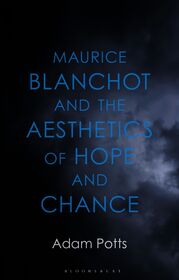
Maurice Blanchot and the Aesthetics of Hope and Chance
-
GET 18% OFF
- Publisher's listprice GBP 85.00
-
38 377 Ft (36 550 Ft + 5% VAT)
The price is estimated because at the time of ordering we do not know what conversion rates will apply to HUF / product currency when the book arrives. In case HUF is weaker, the price increases slightly, in case HUF is stronger, the price goes lower slightly.
- Discount 18% (cc. 6 907 Ft off)
- Discounted price 31 470 Ft (29 971 Ft + 5% VAT)
- Discount is valid until: 31 August 2026
31 470 Ft

Availability
Not yet published.
Why don't you give exact delivery time?
Delivery time is estimated on our previous experiences. We give estimations only, because we order from outside Hungary, and the delivery time mainly depends on how quickly the publisher supplies the book. Faster or slower deliveries both happen, but we do our best to supply as quickly as possible.
Product details:
- Publisher Bloomsbury Publishing (UK)
- Date of Publication 20 August 2026
- ISBN 9781350424722
- Binding Hardback
- No. of pages264 pages
- Size 216x138 mm
- Language 700
Categories
Long description:
Can Maurice Blanchot, so often occupied with thoughts of death, dying, affliction, and impossibility, tell us anything about hope? Conversely, can hope tell us anything about Blanchot's project? Blanchot and the Aesthetics of Hope and Chance offers a bold re-reading of Maurice Blanchot by placing two concepts seldom associated with his work - hope and chance - at its centre.
Against the grain of much Blanchot scholarship, Adam Potts argues that Blanchot's project is a writing animated by a paradoxical hope for the Outside: hope directed not toward possibility, but impossibility. Taking Blanchot's definition of impossibility in his essay 'The Great Refusal' - impossibility as thought that reveals itself 'according to a measure other than that of power' - the book claims that hope for the Outside is both an aesthetic and political concern. Specifically, it contends that language which turns away from power becomes oriented toward the Other. In this turn to alterity, chance helps conceptualise what eludes power.
Alongside Blanchot, Potts traces the intimately complex relationship between hope and chance through key moments and figures in its history - from Yves Bonnefoy, Ernst Bloch, Robin D.G. Kelley, and Gabriel Marcel, to Dada, John Cage, Surrealism, and improvised dance. Through comparative thinking and close readings of The Infinite Conversation and The Step Not Beyond, Potts shows how Blanchot unsettles the concepts of hope and chance, favouring a writing that dwells in suspension and anticipation, where chance interrupts mastery and hope refuses fulfilment.
At once philosophically rigorous and creatively adventurous, Maurice Blanchot and the Aesthetics of Hope and Chance reframes Blanchot as a writer whose work is propelled by a strange, restless, and generative hope - capable of transforming how we understand literature, politics, and experimental practice.
Table of Contents:
Part One: Hope
Chapter 1: Hope as possibility
Chapter 2: Hope as impossibility
Chapter 3: The aesthetics and politics of hope
Part Two: Chance
Chapter 4: Chance and the impossible project
Chapter 5: A practice of chance
Part Three: The Step
Chapter 6: The second step (not beyond)
Afterword

