

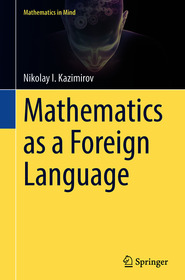
Mathematics as a Foreign Language
Series: Mathematics in Mind;
-
GET 12% OFF
- Publisher's listprice EUR 69.54
-
27 162 Ft (25 868 Ft + 5% VAT)
The price is estimated because at the time of ordering we do not know what conversion rates will apply to HUF / product currency when the book arrives. In case HUF is weaker, the price increases slightly, in case HUF is stronger, the price goes lower slightly.
- Discount 12% (cc. 3 259 Ft off)
- Discounted price 23 902 Ft (22 764 Ft + 5% VAT)
23 902 Ft

Availability
Not yet published.
Why don't you give exact delivery time?
Delivery time is estimated on our previous experiences. We give estimations only, because we order from outside Hungary, and the delivery time mainly depends on how quickly the publisher supplies the book. Faster or slower deliveries both happen, but we do our best to supply as quickly as possible.
Product details:
- Publisher Springer Nature Switzerland
- Date of Publication 9 September 2026
- ISBN 9783032307200
- Binding Hardback
- No. of pages454 pages
- Size 235x155 mm
- Language English
- Illustrations VI, 454 p. 12 illus., 11 illus. in color. 700
Categories
Long description:
This text, structured in two parts, presents a distinctive pedagogical approach to the foundations of mathematics by treating the subject as a formal language to be learned. Its central thesis is that mastery of modern mathematics, logic, and computer science requires fluency in a precise and structured mode of thinking—an “architecture of thought” grounded in a rigorous and expressive language. The book develops a method for learning mathematical language in a way aligned with contemporary foreign language pedagogy, enabling readers to interpret mathematical texts with clarity and precision while gaining insight into their underlying patterns, structures, capabilities, and limitations. In doing so, it bridges the gap between intuitive understanding and formal rigor, complementing standard courses in logic, set theory, algebra, and philosophy.
The text includes approximately 190 exercises of varying difficulty, each accompanied by detailed solutions to support independent study and self-assessment. It also explicitly connects the formal language of mathematics with the operational logic of artificial intelligence. Undergraduate students in mathematics, computer science, philosophy, and linguistics—as well as graduate students seeking a clear and structured review of foundational concepts—will find the book a valuable contribution to their understanding of mathematical formalism. Those interested in the logical principles underlying computer science and AI will likewise find it an engaging resource for deepening their grasp of formal structures.
Part I, The Ascent, serves as a conceptual and intuitive guide, using the metaphor of language acquisition levels (A1 to C1) to develop understanding from the basic syntax of mathematical expressions (the “Matryoshka principle”) to advanced ideas in formal logic and set theory, enriched by analogies, historical context, and philosophical motivation. Part II, Proof-Theoretical Basis, provides the rigorous definitions and proofs underpinning these concepts, completing the transition from intuition to formal precision.
MoreTable of Contents:
Preface.- List of Key Theorems.- I The Ascent.- Survival.- The Threshold of logic.- Formal Logic.- The Foundations of Mathematics.- A mathematician's paradise.- II Proof-Theoretical Basis.- Language.- Logic.- Arithmetic.- Set Theory.- Answers to exercises.- References.- List of Notations.- Index.
More
