

- Publisher's listprice GBP 19.99
-
9 025 Ft (8 595 Ft + 5% VAT)
The price is estimated because at the time of ordering we do not know what conversion rates will apply to HUF / product currency when the book arrives. In case HUF is weaker, the price increases slightly, in case HUF is stronger, the price goes lower slightly.
- Discount 10% (cc. 903 Ft off)
- Discounted price 8 122 Ft (7 736 Ft + 5% VAT)
Subcribe now and take benefit of a favourable price.
Subscribe
9 025 Ft

Availability
Estimated delivery time: In stock at the publisher, but not at Prospero's office. Delivery time approx. 3-5 weeks.
Not in stock at Prospero.
Why don't you give exact delivery time?
Delivery time is estimated on our previous experiences. We give estimations only, because we order from outside Hungary, and the delivery time mainly depends on how quickly the publisher supplies the book. Faster or slower deliveries both happen, but we do our best to supply as quickly as possible.
Product details:
- Publisher OUP USA
- Date of Publication 27 August 2026
- ISBN 9780197829066
- Binding Paperback
- No. of pages280 pages
- Size 234x157x19 mm
- Weight 345 g
- Language English 0
Categories
Short description:
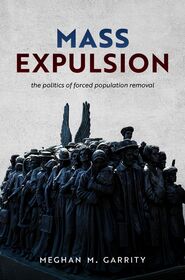
Since the beginning of the twentieth century, governments around the world have expelled, en masse, more than 30 million people. Yet despite its prevalence, mass expulsion remains an understudied phenomenon as scholarly attention has been directed toward the gravest atrocities--genocide and mass killing--or toward forced migration more broadly. Mass Expulsion: The Politics of Forced Population Removal examines why and how governments expel, providing a systematic, cross-regional account of mass expulsion over the longue durée.
MoreLong description:
Since the beginning of the twentieth century, governments around the world have expelled, en masse, more than 30 million people. Yet despite its prevalence, mass expulsion remains an understudied phenomenon as scholarly attention has been directed toward the gravest atrocities--genocide and mass killing--or toward forced migration more broadly. Mass Expulsion: The Politics of Forced Population Removal examines why and how governments expel, providing a systematic, cross-regional account of mass expulsion over the longue durée. Using the original Government-Sponsored Mass Expulsion (GSME) dataset, the book explains when and where expulsion occurs, who is targeted, and what regimes are most likely to expel. The book identifies two overarching categories of mass expulsion--security and economic--and develops a typology of four corresponding types: counter-irredentist, counter-subversive, reprisal, and nativist. It advances a theory of mass expulsion that traces the decision-making process, showing how key structural, proximate, precipitating, and intervening factors combine to shape the conditions under which governments expel or are restrained. Evidence is drawn from archival research conducted at the United Nations High Commissioner for Refugees, the International Committee of the Red Cross, and the League of Nations archives in Geneva, Switzerland.
This research contributes to the fields of international peace and security, political violence, and forced migration. Conceptually, it fills a gap in the literature by systematically examining mass expulsion as a distinct eliminationist policy aimed at the intentional removal of ethnic groups. Theoretically, it extends existing explanations beyond war and security threats, highlighting an entire class of expulsions targeting perceived economic threats. The book deepens our understanding of critical atrocity restraints, demonstrating the importance of alliances, the “homeland” state of the target group, and international organizations. These restraints generate core policy recommendations that seek to spur greater attention to deterring mass expulsion as a priority for atrocity prevention.
Table of Contents:
Introduction
Part I Concepts & Theory
Concept and Data
The Logic of Mass Expulsion
A Theory of Mass Expulsion
Part II Empirics
Nativist Expulsions: South Asians in Postcolonial Uganda and Kenya
Counter-Irredentist Expulsions: Greek Orthodox Christians in the Ottoman Empire
Counter-Subversive Expulsions: Rohingya in Burma
Conclusion
Appendix A: Mass Expulsion in International Law
Appendix B: List of Mass Expulsion Episodes (1900-2020)

