

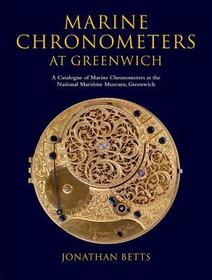
Marine Chronometers at Greenwich
A Catalogue of Marine Chronometers at the National Maritime Museum, Greenwich
- Publisher's listprice GBP 157.50
-
75 245 Ft (71 662 Ft + 5% VAT)
The price is estimated because at the time of ordering we do not know what conversion rates will apply to HUF / product currency when the book arrives. In case HUF is weaker, the price increases slightly, in case HUF is stronger, the price goes lower slightly.
- Discount 10% (cc. 7 525 Ft off)
- Discounted price 67 721 Ft (64 496 Ft + 5% VAT)
Subcribe now and take benefit of a favourable price.
Subscribe
75 245 Ft

Availability
Uncertain availability. Please turn to our customer service.
Why don't you give exact delivery time?
Delivery time is estimated on our previous experiences. We give estimations only, because we order from outside Hungary, and the delivery time mainly depends on how quickly the publisher supplies the book. Faster or slower deliveries both happen, but we do our best to supply as quickly as possible.
Product details:
- Publisher Oxford University Press
- Date of Publication 22 January 2018
- ISBN 9780199641383
- Binding Hardback
- No. of pages784 pages
- Size 366x255x48 mm
- Weight 3674 g
- Language English
- Illustrations w, 500 photos and ill. 0
Categories
Short description:
Marine Chronometers at Greenwich is the fifth, and largest, of the fine series of catalogues of instruments in the National Maritime Museum's collection. This extraordinary collection is generally considered to be the most important of its kind in existence and is housed at the Royal Observatory Greenwich.
MoreLong description:
The Marine Chronometers at Greenwich is the fifth, and largest, of the distinguished series of catalogues of instruments in the collections of the National Maritime Museum. Housed at the Royal Observatory Greenwich - the 'home of time' and the Prime Meridian of the world - this extraordinary collection, which includes the celebrated marine timekeepers by John Harrison (1693-1776), is generally considered to be the finest of its kind in existence.
The book is however much more than just a catalogue, and includes an accessible and engaging history of the chronometer, revealing why these instruments were important in our scientific and cultural history, and explaining, in simple terms, how they worked and were used. A comprehensive Glossary and Bibliography are included to ensure any technicalities are explained and that the reader has suggestions for useful 'further reading'. Over 480 photographs and illustrations, including many fine
macro-photographs and line drawings, illustrate the 'jewel-like' beauty of the chronometer's construction and explain the function and subtleties of its mechanism.
A chapter on 'How the Chronometer was Made', describes the fine sub-division of labour used to create these special machines, from bare metal, right up to delivery on board ship, and brief biographies of the makers tell the human story behind this important nineteenth-century industry. Another chapter, 'The Evolution of the Chronometer', aimed at collectors, historians and curators, provides clearly structured information on assessing and dating the chronometer, something many find difficult.
And, for the dedicated specialist, there is extensive tabulated data on the technical structure of this important collection, a unique resource for future research.
From a scholarly and research perspective I rank the volume under review as one of the most significant horological publications of the last several years. Jonathan Betts deserves the deep gratitude of the global horological community.

