

- Publisher's listprice GBP 9.99
-
4 510 Ft (4 295 Ft + 5% VAT)
The price is estimated because at the time of ordering we do not know what conversion rates will apply to HUF / product currency when the book arrives. In case HUF is weaker, the price increases slightly, in case HUF is stronger, the price goes lower slightly.
- Discount 10% (cc. 451 Ft off)
- Discounted price 4 059 Ft (3 866 Ft + 5% VAT)
Subcribe now and take benefit of a favourable price.
Subscribe
4 510 Ft

Availability
Estimated delivery time: In stock at the publisher, but not at Prospero's office. Delivery time approx. 3-5 weeks.
Not in stock at Prospero.
Why don't you give exact delivery time?
Delivery time is estimated on our previous experiences. We give estimations only, because we order from outside Hungary, and the delivery time mainly depends on how quickly the publisher supplies the book. Faster or slower deliveries both happen, but we do our best to supply as quickly as possible.
Product details:
- Edition number 2
- Publisher OUP Oxford
- Date of Publication 27 February 2020
- ISBN 9780198841715
- Binding Paperback
- No. of pages224 pages
- Size 170x111x14 mm
- Weight 182 g
- Language English
- Illustrations 39 black and white images 40
Categories
Short description:
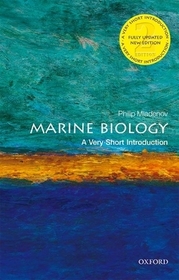
Philip Mladenov examines the nature and variety of life in the oceans, and its importance to us and to the planet. He considers the human impact on these complex ecosystems, through overfishing, pollution, and climate change, and the actions needed to establish a more sustainable relationship, to protect them for future generations.
MoreLong description:
The oceans are our planet's most distinctive and imposing natural habitat. They cover 71 per cent of its surface; support a remarkably diverse and exquisitely adapted array of life forms, from microscopic viruses, bacteria, and plankton to the largest existing animals; and possess many of Earth's most significant, intriguing, and inaccessible ecosystems. In an era in which humans are significantly altering the global environment, the oceans are undergoing rapid and profound changes. The study of marine biology is thus taking on added importance and urgency as people struggle to understand and manage these changes to protect our marine ecosystems. Healthy oceans produce half of the oxygen we breathe; stabilize our climate; create ecosystems that protect our coasts from storms; provide us with abundant food; and host diverse organisms that provide us with natural products for medicine and biotechnology.
In this Very Short Introduction, marine biologist Philip Mladenov provides an accessible and up-to-date overview of marine biology, offering a tour of marine life and marine processes that ranges from the unimaginably abundant microscopic organisms that drive the oceans' food web to the apex predators that we exploit for food; from polar ocean ecosystems to tropical coral reefs; and from the luxurious kelp beds of the coastal ocean to deep-ocean hydrothermal vents where life exists without the energy of the sun. Throughout the book he considers the human impacts on marine life including overfishing, plastic and nutrient pollution, the spread of exotic species, and ocean warming and acidification. He discusses the threats these pose to our welfare, and the actions required to put us on a path to a more sustainable relationship with our oceans so that they can be restored and protected for future generations. Mladenov concludes with a new chapter offering an inspiring vision for the future of our oceans in 2050 that can be realised if we are wise enough to accelerate actions already underway and be bold with implementing new approaches.
The next decade will decide the state of the oceans that we leave behind for future generations.
ABOUT THE SERIES:
The Very Short Introductions series from Oxford University Press contains hundreds of titles in almost every subject area. These pocket-sized books are the perfect way to get ahead in a new subject quickly. Our expert authors combine facts, analysis, perspective, new ideas, and enthusiasm to make interesting and challenging topics highly readable.
Marine Biology represents a useful "very short introduction" for students looking to develop their understanding of the marine field and for enthusiasts and conservationists looking to dive further into the oceans and the life they hold.
Table of Contents:
Acknowledgements
List of illustrations
List of tables
List of abbreviations
Introduction
The oceanic environment
Marine biological processes
Life in the coastal ocean
Polar marine biology
Marine life in the tropics
Deep-ocean biology
Intertidal life
Food from the oceans
The future of our oceans
Further reading
Index

