

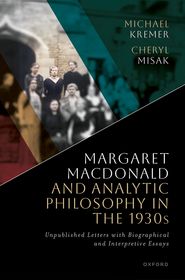
Margaret Macdonald and Analytic Philosophy in the 1930s
Unpublished Letters with Biographical and Interpretive Essays
- Publisher's listprice GBP 77.00
-
34 765 Ft (33 110 Ft + 5% VAT)
The price is estimated because at the time of ordering we do not know what conversion rates will apply to HUF / product currency when the book arrives. In case HUF is weaker, the price increases slightly, in case HUF is stronger, the price goes lower slightly.
- Discount 10% (cc. 3 477 Ft off)
- Discounted price 31 289 Ft (29 799 Ft + 5% VAT)
Subcribe now and take benefit of a favourable price.
Subscribe
34 765 Ft

Availability
Estimated delivery time: In stock at the publisher, but not at Prospero's office. Delivery time approx. 3-5 weeks.
Not in stock at Prospero.
Why don't you give exact delivery time?
Delivery time is estimated on our previous experiences. We give estimations only, because we order from outside Hungary, and the delivery time mainly depends on how quickly the publisher supplies the book. Faster or slower deliveries both happen, but we do our best to supply as quickly as possible.
Product details:
- Publisher OUP Oxford
- Date of Publication 19 August 2025
- ISBN 9780198875734
- Binding Hardback
- No. of pages256 pages
- Size 240x164x22 mm
- Weight 539 g
- Language English 630
Categories
Short description:
This volume examines the important but, until recently, largely forgotten work of the British analytic philosopher Margaret Macdonald. Cheryl Misak and Michael Kremer provide essays on Macdonald's life and work, and an edition of unpublished letters between Macdonald and philosopher Max Black.
MoreLong description:
This volume examines the important but, until recently, forgotten work of the British analytic philosopher Margaret Macdonald. Macdonald's career spanned one of the most significant and fascinating periods in the history of analytic philosophy: the pre-war London of Susan Stebbing as she advanced philosophical analysis; the Cambridge of Ludwig Wittgenstein as he lectured on his new practice-centred philosophy; the Oxford of Gilbert Ryle and ordinary language philosophy; and the post-war London of A.J. Ayer as he defended a version of logical positivism. In this predominantly male, elite world, Macdonald was an anomaly: a woman, abandoned as a child, raised by foster parents and in an orphanage, poor for much of her life. Remarkably, she made a highly respected academic life for herself. A talented philosopher, she was a major influence on Ryle, and one of those few who really understood Wittgenstein during the 1930s. She also helped found, and later edited, the journal Analysis, and was a serious scholar of C. S. Peirce, introducing his complex work to her British colleagues.
Cheryl Misak and Michael Kremer provide a biographical essay, a transcription of a no-longer accessible paper on Peirce, an essay on Macdonald as a scholar of pragmatism, and an essay on her as a scholar of Wittgenstein. The centrepiece is a set of letters from Macdonald to Max Black, written between 1932 and 1937--a crucial time for the development of the analytic school, embracing Cambridge analysis, Viennese logical positivism, Oxford linguistic philosophy, and American pragmatism and neo-realisms. The letters shed light on the cultural, social, and political situation in Britain in the 1930s and its impact on academic life, revealing that, against the mighty obstacles stacked against them, some women in English philosophy before World War II were able to carve out paths as professional philosophers.
Table of Contents:
Margaret Macdonald
Macdonald's Letters to Max Black
'C. S. Peirce on Language'
A Scholar of American Pragmatism,Cheryl Misak
'So first hand': Macdonald's Two Wittgensteins,Michael Kremer
Concluding Remarks

