

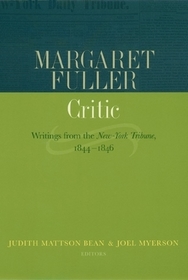
Margaret Fuller, Critic
Writings from the New-York Tribune, 1844-1846
- Publisher's listprice GBP 95.00
-
42 892 Ft (40 850 Ft + 5% VAT)
The price is estimated because at the time of ordering we do not know what conversion rates will apply to HUF / product currency when the book arrives. In case HUF is weaker, the price increases slightly, in case HUF is stronger, the price goes lower slightly.
- Discount 10% (cc. 4 289 Ft off)
- Discounted price 38 603 Ft (36 765 Ft + 5% VAT)
Subcribe now and take benefit of a favourable price.
Subscribe
42 892 Ft

Availability
Temporarily out of stock.
Why don't you give exact delivery time?
Delivery time is estimated on our previous experiences. We give estimations only, because we order from outside Hungary, and the delivery time mainly depends on how quickly the publisher supplies the book. Faster or slower deliveries both happen, but we do our best to supply as quickly as possible.
Product details:
- Publisher Columbia University Press
- Date of Publication 25 October 2000
- ISBN 9780231111324
- Binding Hardback
- No. of pages544 pages
- Language English 0
Categories
Short description:
Margaret Fuller, Critic provides a representative selection from the rich vein of her writings for the New-York Tribune, where she was the paper's first literary editor. From reviews of the writings of Edgar Allen Poe to reflections on such contemporary French novelists as Balzac and George Sand, from investigations into the relationship between race and voting to arguments for on an asylum for discharged female convicts, the scope of Fuller's critical vision is here made manifest.
MoreLong description:
Margaret Fuller, Critic provides a representative selection from the rich vein of her writings for the New-York Tribune, where she was the paper's first literary editor. From reviews of the writings of Edgar Allen Poe to reflections on such contemporary French novelists as Balzac and George Sand, from investigations into the relationship between race and voting to arguments for on an asylum for discharged female convicts, the scope of Fuller's critical vision is here made manifest.
More
