

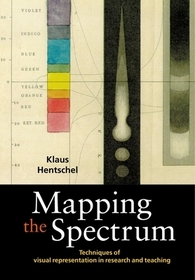
Mapping the Spectrum
Techniques of Visual Representation in Research and Teaching
- Publisher's listprice GBP 207.50
-
93 686 Ft (89 225 Ft + 5% VAT)
The price is estimated because at the time of ordering we do not know what conversion rates will apply to HUF / product currency when the book arrives. In case HUF is weaker, the price increases slightly, in case HUF is stronger, the price goes lower slightly.
- Discount 10% (cc. 9 368 Ft off)
- Discounted price 84 318 Ft (80 303 Ft + 5% VAT)
Subcribe now and take benefit of a favourable price.
Subscribe
93 686 Ft

Availability
printed on demand
Why don't you give exact delivery time?
Delivery time is estimated on our previous experiences. We give estimations only, because we order from outside Hungary, and the delivery time mainly depends on how quickly the publisher supplies the book. Faster or slower deliveries both happen, but we do our best to supply as quickly as possible.
Product details:
- Publisher OUP Oxford
- Date of Publication 7 March 2002
- ISBN 9780198509530
- Binding Hardback
- No. of pages576 pages
- Size 247x176x37 mm
- Weight 1058 g
- Language English
- Illustrations numerous figures and halftones, 4 colour plates 0
Categories
Short description:
This book describes how advances in recording and printing technologies have influenced the research and teaching style of succeeding generations of physicists, chemists, and astronomers, particularly from the boom of spectrum analysis in the 1860s until the advent of quantum mechanics. Seemingly disparate strands such as spectrochemistry and cartography, instrument-design and science education are woven into the rich tapestry of one of the most fascinating and influential research-technologies of the late 19th and early 20th century.
MoreLong description:
Ever since the boom of spectrum analysis in the 1860s, spectroscopy has become one of the most fruitful research technologies in analytic chemistry, physics, astronomy, and other sciences. This book is the first in-depth study of the ways in which various types of spectra, especially the sun's Fraunhofer lines, have been recorded, displayed, and interpreted. The book assesses the virtues and pitfalls of various types of depictions, including hand sketches, woodcuts, engravings, lithographs and, from the late 1870s onwards, photomechanical reproductions. The material of a 19th-century engraver or lithographer, the daily research practice of a spectroscopist in the laboratory, or a student's use of spectrum posters in the classroom, all are looked at and documented here. For pioneers of photography such as John Herschel or Hermann Wilhelm Vogel, the spectrum even served as a prime test object for gauging the color sensitivity of their processes.
This is a broad, contextual portrayal of the visual culture of spectroscopy in the 19th and early 20th centuries. The illustrations are not confined to spectra - they show instruments, laboratories, people at work, and plates of printing manuals.The result is a multifacetted description, focusing on the period from Fraunhofer up to the beginning of Bohr's quantum theory. A great deal of new and fascinating material from two dozen archives has been included. A must for anyone interested in the history of modern science, or in research practice using visual representations.
Mapping the Spectrum is a major contribution to the growing body of studies on science as practice, mainly because of its emphasis on visual representation.
Table of Contents:
Introduction
The spectrum in historical context
The interplay of representational form and purpose
Line matters
The material culture of printing
The rise of photography
Photochemical experimentation, infrared exploration, and the turn towards photometry
Research applications: Pattern recognition
In the classroom laboratory
Epilogue
Appendix
Bibliographic abbreviations
References

