

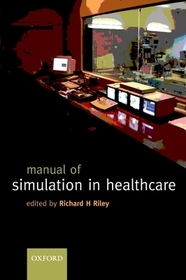
Manual of simulation in healthcare
- Publisher's listprice GBP 43.99
-
19 861 Ft (18 915 Ft + 5% VAT)
The price is estimated because at the time of ordering we do not know what conversion rates will apply to HUF / product currency when the book arrives. In case HUF is weaker, the price increases slightly, in case HUF is stronger, the price goes lower slightly.
- Discount 10% (cc. 1 986 Ft off)
- Discounted price 17 875 Ft (17 024 Ft + 5% VAT)
Subcribe now and take benefit of a favourable price.
Subscribe
19 861 Ft

Availability
Out of print
Why don't you give exact delivery time?
Delivery time is estimated on our previous experiences. We give estimations only, because we order from outside Hungary, and the delivery time mainly depends on how quickly the publisher supplies the book. Faster or slower deliveries both happen, but we do our best to supply as quickly as possible.
Product details:
- Publisher OUP Oxford
- Date of Publication 28 August 2008
- ISBN 9780199205851
- Binding Paperback
- No. of pages568 pages
- Size 247x171x29 mm
- Weight 920 g
- Language English
- Illustrations Numerous black and white photographs and line drawings 0
Categories
Short description:
Medical simulation is a relatively new science that is achieving respectability with healthcare educators worldwide. This practical manual will assist the educator with design, implementation and evaluation of all types of courses in healthcare, especially those that use simulators, training aids and other recent innovations.
MoreLong description:
Medical simulation is a relatively new science that is achieving respectability among healthcare educators worldwide. Simulation and skills centres have become established to integrate simulation into mainstream education in all medical, nursing, and paramedical fields. Borrowing from the experience and methodologies of industries that are using simulation, medical educators are grappling with the problem of rapidly acquiring the skills and techniques required to
implement simulation programmes into established curricula. This book assists both novice and experienced workers in the field to learn from established practitioners in medical simulation. Simulation has been used to enhance the educational experience in a diverse range of fields; therefore a wide
variety of disciplines are represented.
The book begins with a section on the logistics of establishing a simulation and skills centre and the inherent problems with funding, equipment, staffing and course development, and promotion. Section two deals with simulators and related training devices that are required to equip a stand-alone or institution-based centre. The features, strengths, and weaknesses of training devices are presented to help the reader find the appropriate simulator to fulfil their training requirements. There is
a guide to producing scenarios and medical props that can enhance the training experience. The third section covers adult education and it reviews the steps required to develop courses that comply with 'best practice' in medical education. Teaching skills, facilitating problem-based learning groups
and debriefing techniques are especially important to multidisciplinary skills centres that find themselves becoming a centre for medical education. The manual concludes with guides for the major specialties that use simulation, including military, paediatrics, CPR and medical response teams, obstetrics, and anaesthesia.
Table of Contents:
Section One: Simulation Centre Logistics
Simulation and skill centre design
Simulation centre operations and administration
Mobile simulation
Section Two: Simulators, Training Aids & Equipment
Lessons from aviation simulation
Medium and high integration mannequin patient simulators
Airway training devices
Equipment
Cardiopulmonary resuscitation and training devices
Section Three: Education Components
Teaching and learning through the simulated environment
Developing your teaching role in a simulation centre
Teaching in clinical settings
Scenario design - theory to delivery
Debriefing - theory and techniques
Teaching a clinical skill
Training and assessment with standardized patients
Team building and simulation
Problem-based learning for simulation in healthcare
Research in simulation
Section Four: Applied Simulation
Simulation in nurse education
Crisis resource management in healthcare
Intern training - a national simulation-based training program to enhance readiness for medical practice
Non-technical skills - identifying, training and assessing safe behaviours
Simulation training programs for rapid response or medical emergency teams
Simulation in paediatrics
Obstetric simulation
Simulation in emergency medicine
Cardiopulmonary bypass simulation
Simulation for military medical training
Incorporating simulation into the medical school curriculum
Surgical simulation
Creating virtual reality medical simulations - a knowledge-based design and assessment approach
Respiratory medicine and respiratory therapy
Role of cognitive simulations in healthcare
Effective management of anaesthetic crises - design, development and evaluation of a simulation-based course
Simulation in high-stakes performance assessment
Simulation in sedation training for non-anaesthesiologists
Medical educational simulation - a European perspective
Society for Simulation in Healthcare
Glossary

