

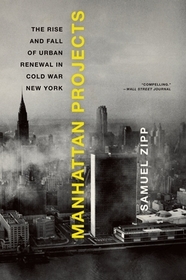
Manhattan Projects
The Rise and Fall of Urban Renewal in Cold War New York
- Publisher's listprice GBP 41.49
-
19 821 Ft (18 877 Ft + 5% VAT)
The price is estimated because at the time of ordering we do not know what conversion rates will apply to HUF / product currency when the book arrives. In case HUF is weaker, the price increases slightly, in case HUF is stronger, the price goes lower slightly.
- Discount 10% (cc. 1 982 Ft off)
- Discounted price 17 839 Ft (16 989 Ft + 5% VAT)
Subcribe now and take benefit of a favourable price.
Subscribe
19 821 Ft

Availability
printed on demand
Why don't you give exact delivery time?
Delivery time is estimated on our previous experiences. We give estimations only, because we order from outside Hungary, and the delivery time mainly depends on how quickly the publisher supplies the book. Faster or slower deliveries both happen, but we do our best to supply as quickly as possible.
Product details:
- Publisher OUP USA
- Date of Publication 26 April 2012
- ISBN 9780199874057
- Binding Paperback
- No. of pages496 pages
- Size 231x152x25 mm
- Weight 680 g
- Language English
- Illustrations 76 halftones 0
Categories
Short description:
In the two decades after World War II, New York was shaken by struggles over urban renewal. Manhattan Projects offers a fresh look at the history of those conflicts, showing how the idea of urban renewal was made and unmade as the state of the art technique for remaking cities.
MoreLong description:
In a book praised by Times Literary Supplement as "richly detailed and thoughtfully written" and by Wall Street Journal as "compelling," Samuel Zipp sheds new light on the rise and fall of urban renewal in the decades after World War II. Focusing on four iconic "Manhattan projects"--the United Nations building, Stuyvesant Town, Lincoln Center, and the great swaths of public housing in East Harlem--Zipp unearths a host of forgotten stories and characters that flesh out the conventional history of urban renewal. He shows how boosters hoped to make Manhattan the capital of modernity and a symbol of American power, but even as the builders executed their plans, a chorus of critics revealed the dark side of those visions, attacking urban renewal for perpetuating deindustrialization, racial segregation, and class division, for uprooting thousands, and for implanting a new, alienating cityscape. Urban renewal was not merely a failed planning ideal, Zipp concludes, but also a crucial phase in the transformation of New York into a world city, but one mired in urban crisis. The book won Honorable Mention for the Ellis W. Hawley Prize of the Organization of American Historians.
Zipp masterfully demonstrates, though, that Manhattan Projects deserves to be surrounded by the best studies of the evolution of post-World War II urbanism, for it is surely one of them.
Table of Contents:
Introduction
Part I: United Nations
1. Clearing the Slum Called War
Part II: Stuyvesant Town
2. Remaking the Ethic of City Rebuilding
3. Th e Mass Home in the Middle-Class Cityscape
Part III: Lincoln Square
4. Culture and Cold War in the Making of Lincoln Center
5. Th e Battle of Lincoln Square
Part IV: East Harlem
6. Cold War Public Housing in the Age of Urban Renewal
7. Confronting the "Mass Way of Life"
Conclusion: Under the Sign of the White Cross
Notes
Index

