

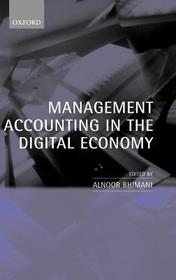
Management Accounting in the Digital Economy
- Publisher's listprice GBP 210.00
-
94 815 Ft (90 300 Ft + 5% VAT)
The price is estimated because at the time of ordering we do not know what conversion rates will apply to HUF / product currency when the book arrives. In case HUF is weaker, the price increases slightly, in case HUF is stronger, the price goes lower slightly.
- Discount 10% (cc. 9 482 Ft off)
- Discounted price 85 334 Ft (81 270 Ft + 5% VAT)
Subcribe now and take benefit of a favourable price.
Subscribe
94 815 Ft

Availability
printed on demand
Why don't you give exact delivery time?
Delivery time is estimated on our previous experiences. We give estimations only, because we order from outside Hungary, and the delivery time mainly depends on how quickly the publisher supplies the book. Faster or slower deliveries both happen, but we do our best to supply as quickly as possible.
Product details:
- Publisher OUP Oxford
- Date of Publication 13 November 2003
- ISBN 9780199260386
- Binding Hardback
- No. of pages316 pages
- Size 243x164x24 mm
- Weight 625 g
- Language English
- Illustrations numerous figures 0
Categories
Short description:
The deployment of digital technologies by enterprises affects not just their functioning in economic terms, but also mobilizes broader social, institutional and organizational effects. This book explores these issues, and looks at the way in which management accounting systems structures, thinking, and practices are being altered as a result.
MoreLong description:
There is mounting evidence that the deployment of digital technologies by enterprises affects not just their functioning in economic terms, but also mobilizes broader social, institutional, and organizational effects. At a technical level, digitization directly influences organizational processes. Notions of its potential also define managerial pursuits and the search for enhanced organizational performance. Inevitably, digitizatoin impacts the form, substance and provenance of internal accounting information with attendant consequences on the behaviour and actions of decision makers.
Knowledge about the influence of digital technologies on management accounting thinking processes and practices is starting to emerge. A variety of issues relating to pricing strategies, cost management and control mechanisms are evident. But the implications for the field are far wider. Aspects of trust, organizational power, cultural shifts, strategization, convergence of product and information elements, and newly perceived contingencies between information dimensions and contextual factors are altering management accounting systems, structures, thinking, and practices. This book explores these and other issues along different planes of reference.
The first part of the book consists of chapters that discuss accounting and management control systems and wider structural shifts connected with the advent of digital technologies. In the second section, the contributors analyse organizationally focused shifts occurring concomitantly alongside digital transformations in the economy. The final part of the book comprises chapters that consider avenues of accounting transformation that may be pursued in specific contexts both in terms of practice and as concepts that afford insights into possible management accounting futures. Broadly, the fourteen chapters of this book bring together practical commentaries, conceptual frameworks, and theoretical argumentation and explore wider narratives regarding the interface between management accounting and the digital economy.
Management Accounting in the Digital Economy will be of interest to scholars, advanced students, and practitioners concerned with the management accounting and control implications of the growing ubiquity of digital technologies across organizational spaces and economic platforms.
Table of Contents:
Digitization and Accounting Change
Section 1: The Transformation of Accounting and Management Controls
Dis-Integration through Integration: The Emergence of Accounting Information Networks
Management Accounting for the Extended Enterprise: Performance Management for Strategic Alliances and Networked Partners
Technology-driven Integration, Automation and Standardization of Business Processes: Implications for Accounting
Expenditures on Competitor Analysis and Information Security: A Management Accounting Perspective
The Changing Role of Management Accounting and Control Systems: Accounting for Knowledge Across Control Domains
Section 2: Reflections on Organizational Shifts
Management Accounting Inscriptions and the Post-Industrial Experience of Organizational Control
Operations, Purchase and Sales in Hyperreality: Implications for Management Control from the Perspective of Institutional Sociology
Not-for-Profit - For Sale: Management Control in and of an Internet Start-up Company
Management Accounting in the New Economy: The Rationale for Irrational Control
Section 3: Reshaping Accounting
Management Control and E-Logistics
Internet Based Information Systems in the Not-for-Profit Sector
Paradoxes of Management and Control in a New Economy Firm
Management Accounting and the Knowledge Production Process

