

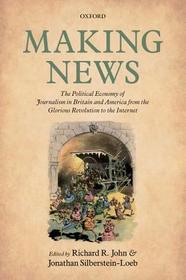
Making News
The Political Economy of Journalism in Britain and America from the Glorious Revolution to the Internet
- Publisher's listprice GBP 34.99
-
15 797 Ft (15 045 Ft + 5% VAT)
The price is estimated because at the time of ordering we do not know what conversion rates will apply to HUF / product currency when the book arrives. In case HUF is weaker, the price increases slightly, in case HUF is stronger, the price goes lower slightly.
- Discount 10% (cc. 1 580 Ft off)
- Discounted price 14 218 Ft (13 541 Ft + 5% VAT)
Subcribe now and take benefit of a favourable price.
Subscribe
15 797 Ft

Availability
printed on demand
Why don't you give exact delivery time?
Delivery time is estimated on our previous experiences. We give estimations only, because we order from outside Hungary, and the delivery time mainly depends on how quickly the publisher supplies the book. Faster or slower deliveries both happen, but we do our best to supply as quickly as possible.
Product details:
- Publisher OUP Oxford
- Date of Publication 31 May 2018
- ISBN 9780198820659
- Binding Paperback
- No. of pages274 pages
- Size 235x156x15 mm
- Weight 430 g
- Language English 0
Categories
Short description:
This book charts the rise and fall of the newspaper as the primary medium for the conveyance of news. Chapters, from the foremost scholars in the field, offer an explicitly comparative analysis of the two of the most influential media markets in the modern world - Great Britain and the United States between 1688 and 1995.
MoreLong description:
This book charts the rise and fall of the newspaper as the primary medium for the conveyance of news. The book focuses on two of the most influential media markets in the modern world-Great Britain and the United States between 1688 and 1995.
In 1688, Parliament created institutional arrangements that would hasten the rise of the newspaper as the dominant medium for the circulation of news. In 1995, the National Science Foundation commercialized the Internet, encouraging an astonishing proliferation of information on all manner of topics, including the news. Per capita newspaper circulation had been declining for decades, partly due to shifting social norms, and partly due to the rise of broadcast news. The Internet exacerbated this trend, partly because it provided a cheaper news source, and partly because it quickly became a superior vehicle for advertising, a major source of revenue for newspaper publishers for over two-hundred-years.
However, only rarely has advertising revenue and direct sales covered costs. Almost never has the demand for news generated the revenue necessary for its supply. Non-market institutional arrangements have ranged from direct government subsidies to organizational forms that enabled news organizations to cooperate. From a historical perspective, the large profits reaped by a handful of newspaper publishers in the post-Second World War era were anomalous, and in no sense a baseline for public policy. Never again will the newspaper be the dominant news medium. To guarantee an informed citizenry in the future, it is necessary to understand how the news business worked in the past.
This book is organized around eight essays-each written by a distinguished specialist, and each explicitly comparative. Its theme is the indispensability in both Great Britain and the United States of non-market institutional arrangements in the provisioning of news.
Media history, business history and journalism studies scholars alike will enjoy these themed essays and their authors perspectives on where our journalism-driven political economy comes from, and where it may be going.
Table of Contents:
Introduction: 'Making News'
The Rise of the Newspaper
News in the Age of Revolution
The Urban Newspaper and the Victorian City
International News in the Age of Empire
Broadcast Journalism in the Interwar Period
Journalism since 1945
Protecting News Before the Internet
Protecting News Today

