

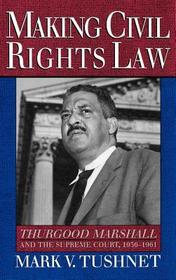
Making Civil Rights Law
Thurgood Marshall and the Supreme Court, 1936-1961
- Publisher's listprice GBP 122.50
-
55 308 Ft (52 675 Ft + 5% VAT)
The price is estimated because at the time of ordering we do not know what conversion rates will apply to HUF / product currency when the book arrives. In case HUF is weaker, the price increases slightly, in case HUF is stronger, the price goes lower slightly.
- Discount 10% (cc. 5 531 Ft off)
- Discounted price 49 778 Ft (47 408 Ft + 5% VAT)
Subcribe now and take benefit of a favourable price.
Subscribe
55 308 Ft

Availability
printed on demand
Why don't you give exact delivery time?
Delivery time is estimated on our previous experiences. We give estimations only, because we order from outside Hungary, and the delivery time mainly depends on how quickly the publisher supplies the book. Faster or slower deliveries both happen, but we do our best to supply as quickly as possible.
Product details:
- Publisher OUP Oxford
- Date of Publication 19 May 1994
- ISBN 9780195084122
- Binding Hardback
- No. of pages416 pages
- Size 242x164x31 mm
- Weight 726 g
- Language English 0
Categories
Short description:
In Making Civil Rights Law, Tushnet provides a chronological narrative history of the legal struggle that preceded the political battles for civil rights, in the thirties, forties, and fifties, waged by the NAACP Legal Defense Fund led by Thurgood Marshall. Tushnet brings clarity to the legal reasoning that animated this `Constitutional revolution', showing how the slow development of doctrine and precedent reflected an overall legal strategy of Marshall and the NAACP.
MoreLong description:
From the 1930s to the early 1960s civil rights law was made primarily through constitutional litigation. Before Rosa Parks could ignite a Montgomery Bus Boycott, the Supreme Court had to strike down the Alabama law which made segregated bus service required by law; before Martin Luther King could march on Selma to register voters, the Supreme Court had to find unconstitutional the Southern Democratic Party's exclusion of African-Americans; and before the March on Washington and the Civil Rights Act of 1964, the Supreme Court had to strike down the laws allowing for the segregation of public graduate schools, colleges, high schools, and grade schools.
Making Civil Rights Law provides a chronological narrative history of the legal struggle, led by Thurgood Marshall and the NAACP Legal Defense Fund, that preceded the political battles for civil rights. Drawing on interviews with Thurgood Marshall and other NAACP lawyers, as well as new information about the private deliberations of the Supreme Court, Tushnet tells the dramatic story of how the NAACP Legal Defense Fund led the Court to use the Constitution as an instrument of liberty and justice for all African-Americans. He also offers new insights into how the justices argued among themselves about the historic changes they were to make in American society.
Making Civil Rights Law provides an overall picture of the forces involved in civil rights litigation, bringing clarity to the legal reasoning that animated this "Constitutional revolution", and showing how the slow development of doctrine and precedent reflected the overall legal strategy of Thurgood Marshall and the NAACP.
Supreme Court history at its best. In a volume rich with documentation that is copious, appropriate, and helpful, few sources seem to have been overlooked.

