

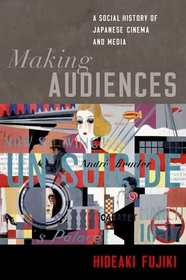
Making Audiences
A Social History of Japanese Cinema and Media
- Publisher's listprice GBP 145.00
-
69 273 Ft (65 975 Ft + 5% VAT)
The price is estimated because at the time of ordering we do not know what conversion rates will apply to HUF / product currency when the book arrives. In case HUF is weaker, the price increases slightly, in case HUF is stronger, the price goes lower slightly.
- Discount 10% (cc. 6 927 Ft off)
- Discounted price 62 346 Ft (59 378 Ft + 5% VAT)
Subcribe now and take benefit of a favourable price.
Subscribe
69 273 Ft

Availability
printed on demand
Why don't you give exact delivery time?
Delivery time is estimated on our previous experiences. We give estimations only, because we order from outside Hungary, and the delivery time mainly depends on how quickly the publisher supplies the book. Faster or slower deliveries both happen, but we do our best to supply as quickly as possible.
Product details:
- Publisher OUP USA
- Date of Publication 14 October 2022
- ISBN 9780197615003
- Binding Hardback
- No. of pages644 pages
- Size 224x155x50 mm
- Weight 998 g
- Language English
- Illustrations 31 illustrations 262
Categories
Short description:
In Making Audiences, author Hideaki Fujiki offers a social history of a century of Japanese cinema and considers the relationships between audience, collectivity, and belonging.
MoreLong description:
Film has always been a key technology for producing and disseminating attachments to 'the social.' Making Audiences explores the century-old relationships between Japanese media and social subjects, analyzing the connections between cinema audiences and five significant discursive terms: minshu (the people), kokumin (the national populace), toa minzoku (the East Asian race), taishu (the masses), and shimin (citizens). Fujiki narrates the history of Japan's transmedia ecology, illuminating cinema's enmeshment with other forms of media, from vaudeville to the internet, so that cinema audiences emerge as simultaneously shaped by and shaping social history. His extensive empirical research and commitment to interdisciplinarity bring new perspective to the history of Japanese society and culture in its global context from the early twentieth century up to the beginning of the twenty-first century, setting his insights within the context of total wars, imperialism, gender, ethnicity, mass society and communication, the ethics of care, citizenship, globalization, neoliberalism, social movements, digital media, and public and intimate spheres. By reorganizing the study of film and its audiences as central players of the history and politics of the 20th century, Fujiki writes the history of Japan and East Asia anew.
Making Audiences offers a profound reconsideration of the relation between cinema and subject formation. Stressing the historical contingency of competing sociopolitical discourses through which the "subjects" of Japanese cinema have emerged, Fujiki enriches our understanding of audiences and spectators, and delineates a counter-hegemonic method for understanding their discursive capture.
Table of Contents:
Introduction
PART I: THE PEOPLE
Chapter 1: The Emergence of the Social Subject: "The People" and the Cinema Audience through Popular Entertainment and Social Education
PART II: THE NATIONAL POPULACE
Chapter 2: Total War and Transmedia Consumer Culture: The Re-definition and Contradictions of "the National Populace"
Chapter 3: Mobilizing Individuals into “the National Populace”: The Cinema Audience from Total War to Postwar
PART III: EAST ASIAN RACE
Chapter 4: Inventing "the East Asian Race:" The Fantasy of the Japanese Empire and Its Mobilization through Cinema
PART IV: THE MASSES
Chapter 5: The Politics of "the Masses" in the Televisual and Atomic Age: Theories of Mass Society, Mass Culture, and Mass Communication
Chapter 6: "The Masses" as Democratic Subjects: Cinema Audiences and the Reassembling of Transmedia Consumer Culture through Television
PART V: CITIZENS
Chapter 7: "Citizens" as Vulnerable Subjects: Individualizing and Networking in the Postwar Period and the Age of Risk
Chapter 8: The Porous Intimate-Public Sphere of "Citizens": Transmedia Social Movement through Independent Film Screening Events and Social Media
Conclusion
Bibliography

