

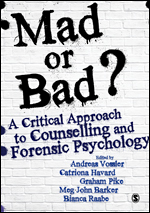
Mad or Bad?: A Critical Approach to Counselling and Forensic Psychology
- Publisher's listprice GBP 35.99
-
17 194 Ft (16 375 Ft + 5% VAT)
The price is estimated because at the time of ordering we do not know what conversion rates will apply to HUF / product currency when the book arrives. In case HUF is weaker, the price increases slightly, in case HUF is stronger, the price goes lower slightly.
- Discount 8% (cc. 1 376 Ft off)
- Discounted price 15 818 Ft (15 065 Ft + 5% VAT)
Subcribe now and take benefit of a favourable price.
Subscribe
17 194 Ft

Availability
printed on demand
Why don't you give exact delivery time?
Delivery time is estimated on our previous experiences. We give estimations only, because we order from outside Hungary, and the delivery time mainly depends on how quickly the publisher supplies the book. Faster or slower deliveries both happen, but we do our best to supply as quickly as possible.
Product details:
- Edition number First Edition
- Publisher SAGE Publications Ltd
- Date of Publication 2 June 2017
- ISBN 9781473963528
- Binding Paperback
- No. of pages400 pages
- Size 242x170 mm
- Language English 0
Categories
Short description:
This book takes a new and innovative approach to looking at the commonalities and disparities between counselling/psychotherapy and forensic psychology. It aims to develop a critical understanding of the themes and issues related to crime and therapy that are highly relevant to theory and practice, yet are often ignored or neglected.
Long description:
A cutting-edge text that provides a comprehensive introduction to mental health problems and criminal behaviour, this book explores the link between mental health and criminality and considers the most common and effective therapeutic approaches for working with offenders and victims of crime.
· Part 1 explores the predominant tensions between forensic and therapeutic agendas;
· Part 2 considers how criminal and ‘insane’ identities and careers may be considered gendered, classed, culturally and age-dependent experiences, and be related to power and oppression;
· Part 3 examines issues around sex and sexuality in forensic and therapeutic settings;
· Part 4 introduces a range of therapeutic approaches for working with offenders and victims of crime;
· Part 5 covers forensic and therapeutic practices, including programmes for the prevention of both mental health issues and offending.
Edited by an expert team from the Open University and written by a broad range of contributors, this book draws on a wealth of experience in this popular subject area. It will be a key text for students of forensic psychology, counselling and psychotherapy, and for health and social care professionals working in therapeutic and forensic settings.
While the title of the book will either attract or repel potential readers, undertaking a critical review of counselling and forensic psychology is to be welcomed. Contributions by expert psychotherapists and clinical, counselling and forensic psychologists working in a multiplicity of forensic settings alongside academics, many with practitioner experience, ensures that a range of views, disciplines and approaches are fully explored. With chapters covering issues such as media representations, identities, sexual offending, diagnosis, treatment, therapeutic practice and prevention, this book is a highly recommended read for students, academics and practitioners interested in mental health and its relationship with criminality.
More
Table of Contents:
Part I: Mad or bad? - Setting the scene
Working therapeutically in forensic settings - Andreas Vossler, Catriona Havard, Meg-John Barker, Graham Pike, Bianca Raabe and Zoe Walkington
Historical overview - Catriona Havard and Katherine D. Watson
Media representations - Troy Cooper and Simon Cross
Diagnosis and categorisation - David Pilgrim
Part II: Mad/bad identities
Race - Hári Sewell
Gender - Jane E.M. Callaghan and Joanne H. Alexander
Age - Emily Glorney
Class - Daniel Holman
Part III: Sex and sexuality in mental health and crime
Sexual assault and abuse - Tara N. Richards and Joan A. Reid
Sex and sexuality in the therapy room - Amanda O'Donovan
‘Paraphilias’ - Jemma Tosh
Sex work - Allan Tyler
Part IV: Treatment
Attachment-based approaches - Mary Haley
Cognitive behavioural therapy - Matt Bruce
Systemic approaches - Andreas Vossler, Brigitte Squire and Clare Bingham
Mindfulness - Meg-John Barker and Troy Cooper
Part V: Dichotomies in forensic and therapeutic practice
Memory - Nadia Wager
Self-harm and suicide - Andrew Reeves and Paul Taylor
Contexts - Henry Strick van Linschoten
Prevention - Nadia Wager and Graham Pike

