

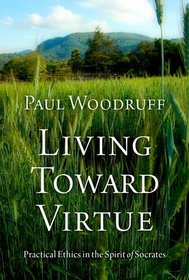
Living Toward Virtue
Practical Ethics in the Spirit of Socrates
- Publisher's listprice GBP 25.49
-
12 177 Ft (11 597 Ft + 5% VAT)
The price is estimated because at the time of ordering we do not know what conversion rates will apply to HUF / product currency when the book arrives. In case HUF is weaker, the price increases slightly, in case HUF is stronger, the price goes lower slightly.
- Discount 10% (cc. 1 218 Ft off)
- Discounted price 10 959 Ft (10 437 Ft + 5% VAT)
Subcribe now and take benefit of a favourable price.
Subscribe
12 177 Ft

Availability
Estimated delivery time: In stock at the publisher, but not at Prospero's office. Delivery time approx. 3-5 weeks.
Not in stock at Prospero.
Why don't you give exact delivery time?
Delivery time is estimated on our previous experiences. We give estimations only, because we order from outside Hungary, and the delivery time mainly depends on how quickly the publisher supplies the book. Faster or slower deliveries both happen, but we do our best to supply as quickly as possible.
Product details:
- Publisher OUP USA
- Date of Publication 9 March 2023
- ISBN 9780197672129
- Binding Hardback
- No. of pages248 pages
- Size 211x147x20 mm
- Weight 413 g
- Language English 294
Categories
Short description:
Paul Woodruff's Living Toward Virtue gives ethics a new start that is practical and down to earth, while resting on a foundation of ancient wisdom. Woodruff draws on the ancient wisdom of Socrates to develop a new approach to an ethical life - one that shows how we can nurture our souls, enjoy a virtuous happiness, and avoid moral injury.
MoreLong description:
In Living toward Virtue, Paul Woodruff shows how we can set about living ethically through self-questioning, which enables us to avoid moral injury by getting clear about what we are doing and why we are doing it. Self-questioning also helps us recognize the limits of our knowledge and so to avoid the danger of self-righteousness. Using real-life examples, Woodruff shows how we can nurture our souls, enjoy a virtuous happiness, and avoid moral injury as much as possible.
This is in the spirit of Socrates, who urged everyone to commit to a lifelong activity of self-examination. By contrast, modern philosophers who follow Aristotle in ethics have mostly taught that living well depends on having virtues that are robust traits of character. Traits are not reliable in all situations, however, and they do not help us make hard decisions. Having a trait is no substitute for the activity we need to practice in order to live toward virtue.
Written for anyone interested in answers to ancient questions about how to live ethically, as well as those engaged with current debates, Living Toward Virtue represents the culmination of decades of scholarship by one of its most distinguished figures.
This engaging, challenging, and timely book will be good supplementary reading for those interested in introductory ethics and ancient philosophy.
Table of Contents:
Preface
Table of Contents
Acknowledgements
About the Author
1. Practical Ethics
1.1. Epimeleisthai
1.2. Ignorance
1.3. Injury: The Wounded Soul
1.4. Impractical Virtue
Appendix to Chapter 1: Moral Injury
2. The Spirit of Socrates
2.1. Socrates' Approach
2.2. Socrates' Way
2.3. Going Beyond Socrates
3. The Shape of Virtue
3.1. An Impossible Assignment: Confucius
3.2. An Activity Good in Itself: Socrates
3.3. The Adverb Problem
3.4. Virtues of Imperfection
3.5. Degrees of Human Virtue
3.6. Self-examination
3.7. Bad Luck and Moral Failure
3.8. The Tragic View of Human Life
4. Aiming at Virtue
4.1. Moral Holidays
4.2. Grand Aims
4.3. Aiming Well: Commitments
4.4. Competing Virtues
4.5. Avoidance: Dilemmas and Injuries
4.6 The Nature of Human Virtue
Appendix to Chapter 4: Moral Dilemmas
5. Human Wisdom and Practical Knowledge
5.1. Ignorance and Aporia
5.2 Self-knowing
5.3. The Limits of Knowledge in Ethics
5.4. The Theory Trap
5.5 Judgment
5.6. Virtues of Imperfection
Appendix 1 to Chapter 5: The Rectification of Names
Appendix 2 to Chapter 5: Socrates on Human Wisdom
6. Resources
6.1. Using Resources
6.2. Internal vs. External Resources
6.3. Community
6.4. Human Nature and Virtue
6.5. Justice
6.6. Differences in Human Environment
6.7. Friendship
6.8. Love
6.9. Expert Advice and Example
6.10. Emotions
6.11. Intuitions vs. Judgments
6.12. Orientation to the Good
Appendix 1 to Chapter 5: The Jewish-Christian Ethics of Love
Appendix 2 to Chapter 5: How Elenchus Succeeds
7. Living Toward Virtue
7.1. The Beautiful Soul
7.2. Love
7.2. Other-regarding Virtues
7.4 Rounding Up the Virtues
7.5 Growth
7.6. Self-repair
7.7. Looking Behind
7.8. Looking Ahead
7.9. Happiness: "Paradise within Thee"
Bibliography

