

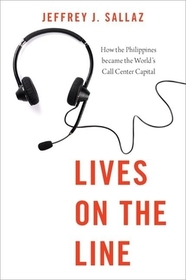
Lives on the Line
How the Philippines became the World's Call Center Capital
Series: Global and Comparative Ethnography;
- Publisher's listprice GBP 30.49
-
13 766 Ft (13 110 Ft + 5% VAT)
The price is estimated because at the time of ordering we do not know what conversion rates will apply to HUF / product currency when the book arrives. In case HUF is weaker, the price increases slightly, in case HUF is stronger, the price goes lower slightly.
- Discount 10% (cc. 1 377 Ft off)
- Discounted price 12 389 Ft (11 799 Ft + 5% VAT)
Subcribe now and take benefit of a favourable price.
Subscribe
13 766 Ft

Availability
Estimated delivery time: In stock at the publisher, but not at Prospero's office. Delivery time approx. 3-5 weeks.
Not in stock at Prospero.
Why don't you give exact delivery time?
Delivery time is estimated on our previous experiences. We give estimations only, because we order from outside Hungary, and the delivery time mainly depends on how quickly the publisher supplies the book. Faster or slower deliveries both happen, but we do our best to supply as quickly as possible.
Product details:
- Publisher OUP USA
- Date of Publication 5 September 2019
- ISBN 9780190630669
- Binding Paperback
- No. of pages256 pages
- Size 155x231x20 mm
- Weight 476 g
- Language English
- Illustrations 21 black and white illustrations 0
Categories
Short description:
Dial just about any toll-free number and chances are you'll be talking to a Filipino. In fact, around the year 2005, the country overtook India as the world's "voice capital." Lives on the Line argues that this has nothing to do with wages or accents. Rather, as Jeffrey J. Sallaz shows, there is a perfect match between offshored call centers and educated young Filipinos. For Filipina women and gay Filipinos in particular, call centers are veritable lifelines, and their lives tell us much about contemporary capitalism and the future of work.
MoreLong description:
The call center industry is booming in the Philippines. Around the year 2005, the country overtook India as the world's "voice capital," and industry revenues are now the second largest contributor to national GDP. In Lives on the Line, Jeffrey J. Sallaz retraces the assemblage of a global market for voice over the past two decades. Drawing upon case studies of sixty Filipino call center workers and two years of fieldwork in Manila, he illustrates how offshore call center jobs represent a middle path for educated Filipinos, who are faced with the dismaying choice to migrate abroad in search of prosperity versus stay at home as an impoverished professional. A rich ethnographic study, this book challenges existing stereotypes regarding offshore service jobs and sheds light upon the reasons that the Philippines has become the world's favored location for "voice." It looks beyond call centers and beyond India to advance debates concerning global capitalism, the future of work, and the lives of those who labor in offshored jobs.
MoreTable of Contents:
Part 1 Introduction
1: One Job, Many Lives
2: Assembling a Labor Market
Part 2 Mediators Unpacked
3: Firms: Seeing Like a Call Center
4: The State: Making a Middle Path
5: Labor: Seeking the Philippine Dream
Part 3 Three Archetypes
6: Responsible Women
7: Restless Gays
8: Rooted Men
Part 4 Conclusion
9: Gone Baby Gone
10: The Relativity of Work
Appendix
An Ethnographic Narrative
Acknowledgements
Notes
Index

