

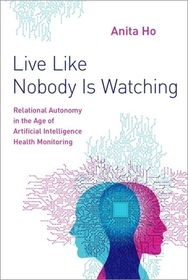
Live Like Nobody Is Watching
Relational Autonomy in the Age of Artificial Intelligence Health Monitoring
- Publisher's listprice GBP 27.49
-
12 411 Ft (11 820 Ft + 5% VAT)
The price is estimated because at the time of ordering we do not know what conversion rates will apply to HUF / product currency when the book arrives. In case HUF is weaker, the price increases slightly, in case HUF is stronger, the price goes lower slightly.
- Discount 20% (cc. 2 482 Ft off)
- Discounted price 9 929 Ft (9 456 Ft + 5% VAT)
- Discount is valid until: 30 June 2026
Subcribe now and take benefit of a favourable price.
Subscribe
12 411 Ft

Availability
Estimated delivery time: In stock at the publisher, but not at Prospero's office. Delivery time approx. 3-5 weeks.
Not in stock at Prospero.
Why don't you give exact delivery time?
Delivery time is estimated on our previous experiences. We give estimations only, because we order from outside Hungary, and the delivery time mainly depends on how quickly the publisher supplies the book. Faster or slower deliveries both happen, but we do our best to supply as quickly as possible.
Product details:
- Publisher OUP USA
- Date of Publication 14 June 2023
- ISBN 9780197556269
- Binding Hardback
- No. of pages336 pages
- Size 203x147x43 mm
- Weight 476 g
- Language English 412
Categories
Short description:
As our society embraces expanding forms of personal and health monitoring, particularly with the use of artificial intelligence (AI), how may these technologies change the way we define what it means to live a free and healthy life? Drawing on the examples of home health monitoring, direct-to-consumer health apps, and medication adherence monitoring, this book explores the socio-relational contexts that are framing the promotion of AI health monitoring, and the potential consequences of the proliferation of these technologies. It argues for a relational conception of autonomy and explores how socio-systemic conditions shape the cultural meanings of personal responsibility, healthy living and aging, trust, and caregiving in the era of big data and AI. This book proposes ethical strategies that can help preserve and promote people's relational autonomy in the digital era.
MoreLong description:
Respect for patient autonomy and data privacy are generally accepted as foundational western bioethical values. Nonetheless, as our society embraces expanding forms of personal and health monitoring, particularly in the context of an aging population and the increasing prevalence of chronic diseases, questions abound about how artificial intelligence (AI) may change the way we define or understand what it means to live a free and healthy life. Who should have access to our health and recreational data and for what purpose? How can we find a balance between users' physical safety and their autonomy? Should we allow individuals to forgo continuous health monitoring, even if such monitoring may minimize injury risks and confer health and societal benefits? Would being continuously watched by connected devices ironically render patients more isolated and their data more exposed than ever?
Drawing on different use cases of AI health monitoring, this book explores the socio-relational contexts that frame the promotion of AI health monitoring, as well as the potential consequences of such monitoring for people's autonomy. It argues that the evaluation, design, and implementation of AI health monitoring should be guided by a relational conception of autonomy, which addresses both people's capacity to exercise their agency and broader issues of power asymmetry and social justice. It explores how interpersonal and socio-systemic conditions shape the cultural meanings of personal responsibility, healthy living and aging, trust, and caregiving. These norms in turn structure the ethical space within which expectations regarding predictive analytics, risk tolerance, privacy, self-care, and trust relationships are expressed. Through an analysis of home health monitoring for older and disabled adults, direct-to-consumer health monitoring devices, and medication adherence monitoring, this book proposes ethical strategies at both the professional and systemic levels that can help preserve and promote people's relational autonomy in the digital era.
AI-enabled home health monitoring, care delivery and health apps are transforming healthcare. Using the lens of relational autonomy theory, Anita Ho carefully assesses both the potential benefits of these technologies and the ethical challenges they raise for users' autonomy. She demonstrates the importance of situating AI health technologies in a wider socio-relational context, and argues that to truly enhance users' autonomy, these technologies should complement, rather than replace the therapeutic relationship. Timely, informative and thoroughly researched, Ho's book makes an important contribution to contemporary debates about AI and healthcare.
Table of Contents:
Abbreviations
Acknowledgments
Preface
Introduction
Chapter 1: Artificial Autonomy or Relational Intelligence: How Relationality Matters in Health Monitoring
Chapter 2: Independent Living With(out) Privacy: AI Home Health Monitoring
Chapter 3: Artificial Doctoring: The Case of Direct-to-Consumer Health Monitoring
Chapter 4: A Digital Pill to Swallow: AI Monitoring for Medication Adherence and Therapeutic Relationship
Chapter 5: From One-Way Mirror to Two-Way Street: Realigning Goals and Practices of AI Health Monitoring
Prologue
Bibliography
Index

