

- Publisher's listprice GBP 31.99
-
14 443 Ft (13 755 Ft + 5% VAT)
The price is estimated because at the time of ordering we do not know what conversion rates will apply to HUF / product currency when the book arrives. In case HUF is weaker, the price increases slightly, in case HUF is stronger, the price goes lower slightly.
- Discount 10% (cc. 1 444 Ft off)
- Discounted price 12 998 Ft (12 380 Ft + 5% VAT)
Subcribe now and take benefit of a favourable price.
Subscribe
14 443 Ft

Availability
cancelled
Why don't you give exact delivery time?
Delivery time is estimated on our previous experiences. We give estimations only, because we order from outside Hungary, and the delivery time mainly depends on how quickly the publisher supplies the book. Faster or slower deliveries both happen, but we do our best to supply as quickly as possible.
Product details:
- Publisher McGraw Hill TAB
- Date of Publication 16 November 2005
- ISBN 9780071444842
- Binding Paperback
- No. of pages287 pages
- Size 233x185x20 mm
- Weight 527 g
- Language English 0
Categories
Short description:
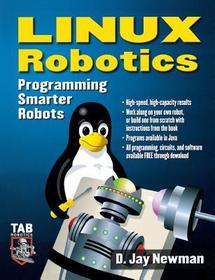
Learn everything you need to unleash the power of Linux when you build your own ?smarter? robot with high-speed, high-capacity results.
MoreLong description:
Publisher's Note: Products purchased from Third Party sellers are not guaranteed by the publisher for quality, authenticity, or access to any online entitlements included with the product.
Robotics is becoming an increasingly popular field for hobbyists and professionals alike
The cost of the mechanics and electronics required to build a robot are low enough that almost anybody can afford it. The hardware that used to require government funding or a large university is now available to the average person. At the same time, programming is becoming a more common skill.
This book combines the most sophisticated parts of robotics and programming to fill a real gap in available information.Most robotics books today use microcontrollers as the ?brains? of the robots. This approach is fine for smaller, less expensive projects, but has serious limitations. When attempting to build a robot with sophisticated movements, navigation abilities, vision, and picture-capturing abilities, it is better to use a single board computer (SBC) such as Linux as the controller.
Publisher's Note: Products purchased from Third Party sellers are not guaranteed by the publisher for quality, authenticity, or access to any online entitlements included with the product.
Robotics is becoming an increasingly popular field for hobbyists and professionals alike
The cost of the mechanics and electronics required to build a robot are low enough that almost anybody can afford it. The hardware that used to require government funding or a large university is now available to the average person. At the same time, programming is becoming a more common skill.
This book combines the most sophisticated parts of robotics and programming to fill a real gap in available information.Most robotics books today use microcontrollers as the ?brains? of the robots. This approach is fine for smaller, less expensive projects, but has serious limitations. When attempting to build a robot with sophisticated movements, navigation abilities, vision, and picture-capturing abilities, it is better to use a single board computer (SBC) such as Linux as the controller.

