

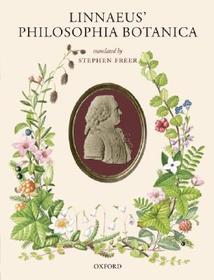
Linnaeus' Philosophia Botanica
- Publisher's listprice GBP 80.00
-
36 120 Ft (34 400 Ft + 5% VAT)
The price is estimated because at the time of ordering we do not know what conversion rates will apply to HUF / product currency when the book arrives. In case HUF is weaker, the price increases slightly, in case HUF is stronger, the price goes lower slightly.
- Discount 10% (cc. 3 612 Ft off)
- Discounted price 32 508 Ft (30 960 Ft + 5% VAT)
Subcribe now and take benefit of a favourable price.
Subscribe
36 120 Ft

Availability
printed on demand
Why don't you give exact delivery time?
Delivery time is estimated on our previous experiences. We give estimations only, because we order from outside Hungary, and the delivery time mainly depends on how quickly the publisher supplies the book. Faster or slower deliveries both happen, but we do our best to supply as quickly as possible.
Product details:
- Publisher OUP Oxford
- Date of Publication 2 June 2005
- ISBN 9780198569343
- Binding Paperback
- No. of pages432 pages
- Size 246x189x23 mm
- Weight 814 g
- Language English
- Illustrations 11 line drawings and 2 halftones 0
Categories
Short description:
In this new translation of Philosophia Botanica, example pages from Linnaeus' original Latin text are presented alongside Stephen Freer's English translation of the complete text. The book contains images of all eleven of the original plates, which illustrate the shapes of leaves and other plant structures and forms. Also included are Linnaeus' explanations of the effects of soil and climatic conditions on plant growth, plus six short memoranda that describe Linnaeus' botanical excursions, his ideas for garden lay-out and herbarium construction, and his thoughts on what was required of a botanist and his pupils. The Introduction, dedicated to the memory of Professor William Stearn is by Professor Paul Alan Cox of the National Tropical Botanical Gardens, Hawaii.
This beautifully presented translation of Philosophia Botanica, is a valuable resource to botanists, taxonomists, historians and all interested individuals, who will gain greater access to, and new insights into, the work of Carl Linnaeus, the father of modern systematics.
Long description:
Carl Linnaeus (1707-1778) was a Swedish botanist, physician, and zoologist, who laid the foundations of modern biological systematics and nomenclature. Inspired by the work of his predecessors and contemporaries, Linnaeus was the first scientist to develop a coherent system for describing, classifying and naming organisms. The method he developed, known as binominal nomenclature, is the classification system still used in botany and zoology today.
Philosophia Botanica was first published in 1751. Its publication followed that of several earlier works written by Linnaeus such as his Systema Naturae (1735) and Fundamenta Botanica (1736). Philosophia Botanica is an expanded version of Fundamenta Botanica with added commentary, and represents a critical stage in the evolution of Linnaeus' ideas and the development of his binominal nomenclature applied to plants.
In this new translation of Philosophia Botanica, example pages from Linnaeus' original Latin text are presented alongside Stephen Freer's English translation of the complete text. The book contains images of all eleven of the original plates, which illustrate the shapes of leaves and other plant structures and forms. Also included are Linnaeus' explanations of the effects of soil and climatic conditions on plant growth, plus six short memoranda that describe Linnaeus' botanical excursions, his ideas for garden lay-out and herbarium construction, and his thoughts on what was required of a botanist and his pupils. The Introduction, dedicated to the memory of Professor William Stearn is by Professor Paul Alan Cox of the National Tropical Botanical Gardens, Hawaii.
This beautifully presented translation of Philosophia Botanica, is a valuable resource to botanists, taxonomists, r storians and all interested individuals, who will gain greater access to, and new insights into, the work of Carl Linnaeus, the father of modern systematics.
Philosophia Botanica is certainly a must on the shelves of anyone interested in the history and philosophy of the life sciences.
Table of Contents:
INTRODUCTION
The Library
Systems
Plants
The Fruit Body
Sex
Characters
Names
Definitions
Varieties
Synonyms
Sketches
Potencies
PLATES
APPENDICES

