

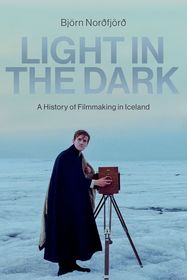
Light in the Dark
A History of Filmmaking in Iceland
- Publisher's listprice GBP 86.00
-
41 086 Ft (39 130 Ft + 5% VAT)
The price is estimated because at the time of ordering we do not know what conversion rates will apply to HUF / product currency when the book arrives. In case HUF is weaker, the price increases slightly, in case HUF is stronger, the price goes lower slightly.
- Discount 10% (cc. 4 109 Ft off)
- Discounted price 36 978 Ft (35 217 Ft + 5% VAT)
Subcribe now and take benefit of a favourable price.
Subscribe
41 086 Ft

Availability
Estimated delivery time: Expected time of arrival: end of January 2026.
Not in stock at Prospero.
Why don't you give exact delivery time?
Delivery time is estimated on our previous experiences. We give estimations only, because we order from outside Hungary, and the delivery time mainly depends on how quickly the publisher supplies the book. Faster or slower deliveries both happen, but we do our best to supply as quickly as possible.
Product details:
- Publisher OUP USA
- Date of Publication 21 May 2025
- ISBN 9780197762141
- Binding Hardback
- No. of pages280 pages
- Size 239x165x22 mm
- Weight 562 g
- Language English
- Illustrations 35 film stills 664
Categories
Short description:
Light in the Dark tells the dramatic history of Icelandic cinema from its modest origin in the early twentieth century to the heterogenous and complex national cinema of today. In tracing this wide-ranging history, author Björn Norðfjörð describes the constant tug between local and national cultural forces and the transnational and global pull of world cinema.
MoreLong description:
Light in the Dark tells the dramatic history of Icelandic cinema from its modest origin in the early twentieth century to the heterogenous and complex national cinema of today. In tracing this wide-ranging history, author Björn Norðfjörð describes the constant tug between local and national cultural forces and the transnational and global pull of world cinema.
Norðfjörð starts by casting light on the earliest films made in the country, expanding outward to survey Scandinavians adaptations of Icelandic literature filmed during the late silent period, documentaries of the interwar period, and the first narrative features following the end of World War II and national independence. He traces the emergence of national cinema proper to the 1980s, with the foundation of the Icelandic Film Fund, explores the subsequent impact of first European art cinema and then Hollywood genre cinema, and finally considers the remarkable international success of Icelandic cinema in the twentieth-first century. Along the way, Norðfjörð draws attention to many additional issues and topics regarding Icelandic cinema, including depictions of nature and animals, the aesthetics of fire and ice, the role of film adaptation, the impact of Nordic noir and crime fiction, Hollywood runaway productions, and the question of women's cinema in Icelandic filmmaking. Throughout the book, films from all periods of Icelandic filmmaking are analysed in detail with equal emphasis on content and form, including both lesser known titles and key films like The Outlaw and His Wife (Victor Sjöström, 1917), Salka Valka (Arne Mattson, 1954), Land and Sons (Ágúst Guðmundsson, 1980), When the Raven Flies (Hrafn Gunnlaugsson, 1984), Cold Fever (Friðrik Þór Friðriksson, 1995), 101 Reykjavík (Baltasar Kormákur), Rams (Grímur Hákonarson, 2015) and Godland (Hlynur Pálmason, 2022).
Light in the Dark offers a startlingly illuminating account of Iceland's contribution to the dynamics of world cinema. Spanning the entirety of the 20th century and part of the 21st, this distinctive work deftly shows us what transnational cinema, world cinema, and national cinema look like in the context of the extra-small nation of Iceland.
Table of Contents:
Preface
Introduction
Chapter One: Overview I: 1901-1979
Chapter Two: Iceland in Living Pictures
Chapter Three: Adapting a Literary Nation to Film
Chapter Four: A Cinema of Fire and Ice
Chapter Five: Overview II: 1980-1999
Chapter Six: The Countryside versus The City
Chapter Seven: The Transnational Imperative
Chapter Eight: Adaptation as Transnationalization
Chapter Nine: Overview III: 2000-2020
Chapter Ten: Crime Fiction, Film and Television
Chapter Eleven: Hollywood Does Iceland
Chapter Twelve: Icelandic Women's Cinema
Chapter Thirteen: Animals and Nature
Epilogue
Bibliography
Index

