

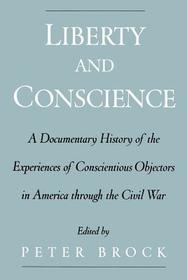
Liberty and Conscience
A Documentary History of Conscientious Objectors in America through the Civil War
- Publisher's listprice GBP 71.00
-
33 920 Ft (32 305 Ft + 5% VAT)
The price is estimated because at the time of ordering we do not know what conversion rates will apply to HUF / product currency when the book arrives. In case HUF is weaker, the price increases slightly, in case HUF is stronger, the price goes lower slightly.
- Discount 10% (cc. 3 392 Ft off)
- Discounted price 30 528 Ft (29 075 Ft + 5% VAT)
Subcribe now and take benefit of a favourable price.
Subscribe
33 920 Ft

Availability
printed on demand
Why don't you give exact delivery time?
Delivery time is estimated on our previous experiences. We give estimations only, because we order from outside Hungary, and the delivery time mainly depends on how quickly the publisher supplies the book. Faster or slower deliveries both happen, but we do our best to supply as quickly as possible.
Product details:
- Publisher OUP USA
- Date of Publication 18 April 2002
- ISBN 9780195151220
- Binding Paperback
- No. of pages208 pages
- Size 235x160x16 mm
- Weight 331 g
- Language English 0
Categories
Short description:
While conscientious objection in the twentieth century has been well documented, there has been surprisingly little study of its long history in America's early conflicts. Peter Brock, one of the foremost historians of American pacifism, seeks to remedy this oversight by presenting a rich and varied collection of documents, many drawn from obscure sources, that shed new light on American religious and military history. These include legal findings, church and meeting proceedings, appeals by non-conformists to government authorities, and illuminating excerpts from personal journals.One of the most striking features to emerge from these documents is the critical role of religion in the history of American pacifism. Brock finds that virtually all who refused military service in this period were inspired by religious convictions, with Quakers frequently being the most ardent dissenters. A dramatic, powerful portrait of early American pacifism, Liberty and Conscience presents not only the thought and practice of the objectors themselves, but also the response of the authorities and the general public.
MoreLong description:
Although the act of conscientious objection entered modern consciousness largely as a result of the Vietman War, Americans have, in fact, long struggled to reconcile their politics and pacifist beliefs with compulsory military service. While conscientious objection in the twentieth century has been well documented, there has been surprisingly little study of its long history in America's early conflicts, defined as these have been by accounts of patriotism and nation-building. During the period of conscription from the late 1650s to the end of the Civil War, many North Americans refused military service on moral grounds.
In this volume, Peter Brock, one of the foremost historians of American pacifism, seeks to remedy this oversight by presenting a rich and varied collection of documents, many drawn from obscure sources, that shed new light on American religious and military history. These include legal findings, church and meeting proceedings, appeals by nonconformists to government authorities, and illuminating excerpts from personal journals. These accounts contain many poignant, often painful, and sometimes even humorous episodes that offer glimpses into the lives of conscientious objectors of the era.
One of the most striking features to emerge from these documents is the critical role of religion in the history of American pacifism. Brock finds that virtually all who refused military service in this period were inspired by religious convictions, with Quakers frequently the most ardent dissenters. Only in the antebellum period did the pacifist spectrum expand to include nonsectarians such as the famous abolitionist William Lloyd Garrison, founder of the New England Non-Resistance Society. A dramatic and powerful portrait of early American pacifism, Liberty and Conscience presents not only the thought and practice of the objectors themselves, but also the response of the authorities and the general public.
Peter Brock's fine documentary history is a welcome addition to the scant literature on the history of conscientious objection.Brock's work makes it clear that those who refute the state in the name of transcendent values, today and in the future, are heirs to a rich historical legacy.

