

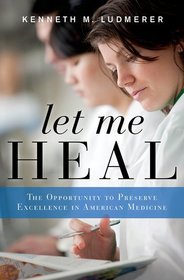
Let Me Heal
The Opportunity to Preserve Excellence in American Medicine
- Publisher's listprice GBP 40.99
-
19 582 Ft (18 650 Ft + 5% VAT)
The price is estimated because at the time of ordering we do not know what conversion rates will apply to HUF / product currency when the book arrives. In case HUF is weaker, the price increases slightly, in case HUF is stronger, the price goes lower slightly.
- Discount 10% (cc. 1 958 Ft off)
- Discounted price 17 624 Ft (16 785 Ft + 5% VAT)
Subcribe now and take benefit of a favourable price.
Subscribe
19 582 Ft

Availability
printed on demand
Why don't you give exact delivery time?
Delivery time is estimated on our previous experiences. We give estimations only, because we order from outside Hungary, and the delivery time mainly depends on how quickly the publisher supplies the book. Faster or slower deliveries both happen, but we do our best to supply as quickly as possible.
Product details:
- Publisher OUP USA
- Date of Publication 23 October 2014
- ISBN 9780199744541
- Binding Hardback
- No. of pages456 pages
- Size 152x236x43 mm
- Weight 726 g
- Language English 0
Categories
Short description:
This insightful,engaging the history of US graduate medical education explores the social and moral value of physician training to society as a whole and how improving excellence in GME can stimulate and guide meaningful health care reform.
MoreLong description:
In Let Me Heal, prize-winning author Kenneth M.Ludmerer provides the first-ever account of the residency system for training doctors in the United States and, by tracing its evolution, explores how the residency system is of fundamental importance to the health of the nation.
In the making of a doctor, the residency system represents the dominant formative influence. It is during the three to nine years spent in residency that doctors come of professional age, acquiring the knowledge and skills of their specialty or subspecialty, forming a professional identify, and developing habitts, behaviors, attitudes, and values that last a professional lifetime. Let Me Heal examines all dimensions of the residency system: historical evolution, educational principles, moral underpinnings, financing and administration, and cultural components. It focuses on the experience of being a resident, on how that experience has changed over time, and on how well the residency system is fulfilling its obligation to produce outstanding doctors. Most importantly, it analyzes the mutual relationship beetween residency education and patient care in America. The book shows that the quality of residency training ultimately depends on the quality of patient care that residents observe, but that there is much that residency training can do to produce doctors who practice in a better, more affordable fashion.
This thoughtful scholarly treatise on the residency, the most influential learning period for young physicians, is a major contribution to our understanding of how America produces its physician workforce. It notes the educational, scientific, economic, social, legal, ethical, and political influences which produce tensions and conflicts in the training experience. Dr. Ludmerer provides a platform for examining these influences and he proposes ways for the learning environment to be more flexible, while maintaining high standards and the professionalism we all want to retain in our nation's physicians. I heartily recommend this superb book to all who are interested in our nation's healthcare system.
Table of Contents:
1. ANTECEDENTS
The Search for Clinical Experience
The Quest for Specialty Training
The Passion for Discovery and the Birth of Clinical Science
2. JOHNS HOPKINS AND THE CREATION OF THE RESIDENCY
Graduate Medical Education Enters the University
The Scientific Practitioner and the Promise for the Nation
Work as Play
Diaspora
3. THE GROWTH OF GRADUATE MEDICAL EDUCATION
Completing the Infrastructure
The Maturation of the Internship
The Spread of the Residency
In Search of a System
4. THE AMERICAN RESIDENCY
Educational Principles
The Moral Dimension of Graduate Medical Education
The Learning Environment
Cultural Influences
5. THE LIFE OF A PRE-WORLD WAR II HOUSE OFFICER
Obtaining a Residency
Experiencing the Residency
Education and Service
6. CONSOLIDATING THE SYSTEM
The Second Reform of Medical Education
The Rise of the Specialty Boards and the Triumph of Residency
Graduate Medical Education and the Public Good
7. THE EXPANSION OF THE RESIDENCY IN AN ERA OF ABUNDANCE
From Privilege to Right
The Maturation of Clinical Science and the Creation of Subspecialty Fellowships
The Ascendance of Specialty Practice
The Propagation of Wastefulness
8. THE EVOLVING LEARNING ENVIRONMENT
The Decline of the Ward Service
The Preservation of Educational Quality
Maintaining the Moral Mission
9. THE LIFE OF A POST-WORLD WAR II HOUSE OFFICER
Changes and Continuities
Quality, Safety, and Supervision
Education and Service, Again
10. THE WEAKENING OF THE EDUCATIONAL COMMUNITY
The Marginalization of House Officers
House Staff Activism
The Discovery of Burnout
11. THE ERA OF HIGH THROUGHPUT
The New Learning Environment
The Subversion of the Moral Mission
Changing Attitudes toward Work and Life
12. THE ERA OF ACCOUNTABILITY, PATIENT SAFETY, AND WORK-HOURS REGULATION
Work Hours Restriction
Perpetual Dilemmas
13. PRESERVING EXCELLENCE IN RESIDENCY TRAINING AND MEDICAL CARE
Challenges, New and Old
Aligning Education and Patient Care

