

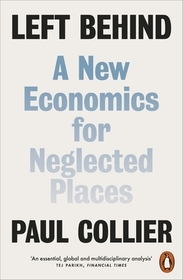
Left Behind
A New Economics for Neglected Places
- Publisher's listprice GBP 10.99
-
5 250 Ft (5 000 Ft + 5% VAT)
The price is estimated because at the time of ordering we do not know what conversion rates will apply to HUF / product currency when the book arrives. In case HUF is weaker, the price increases slightly, in case HUF is stronger, the price goes lower slightly.
- Discount 15% (cc. 788 Ft off)
- Discounted price 4 463 Ft (4 250 Ft + 5% VAT)
Subcribe now and take benefit of a favourable price.
Subscribe
5 250 Ft

Availability
Estimated delivery time: Expected time of arrival: end of January 2026.
Not in stock at Prospero.
Why don't you give exact delivery time?
Delivery time is estimated on our previous experiences. We give estimations only, because we order from outside Hungary, and the delivery time mainly depends on how quickly the publisher supplies the book. Faster or slower deliveries both happen, but we do our best to supply as quickly as possible.
Product details:
- Publisher Penguin Books Ltd
- Date of Publication 12 June 2025
- Number of Volumes B-format paperback
- ISBN 9780141984117
- Binding Paperback
- No. of pages304 pages
- Size 198x130x18 mm
- Weight 222 g
- Language English 670
Categories
Long description:
A FINANCIAL TIMES BEST BOOK OF 2024
The world-renowned economist offers a ground-breaking new vision for inclusive prosperity
Left behind places can be found in prosperous countries—from South Yorkshire, integral to the industrial revolution and now England’s poorest county, to Barranquilla, once Colombia’s portal to the Caribbean and now struggling. More alarmingly, the poorest countries in the world are diverging further from the rest of humanity than they were at the start of this century. Why have these places fallen behind? And what can we do about it?
World-renowned development economist Paul Collier has spent his life working in neglected communities. In this book he offers his candid diagnosis of why some regions and countries are failing, and a new vision for how they can catch up. Collier lays the blame for widening inequality on stale economic orthodoxies that prioritize market forces to revive left behind regions, and on the arrogant, hands-off and one-size fits all approach of centralized bureaucracies like the UK Treasury. As a result, Collier argues, the UK has become the most unequal and unfair society in the western world.
Yet the core message of Left Behind is hopeful: bringing together encouraging case studies of recovery from around the world, Collier shows how renewal is achievable through a combination of collective learning, moral leadership and local agency. With keen insight, he draws lessons from such seemingly disparate fields as behavioural psychology, evolutionary biology and moral philosophy to share a bold, galvanizing vision for a more inclusive, prosperous world.

