

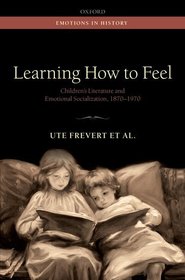
Learning How to Feel
Children's Literature and Emotional Socialization, 1870-1970
Series: Emotions In History;
- Publisher's listprice GBP 135.00
-
60 952 Ft (58 050 Ft + 5% VAT)
The price is estimated because at the time of ordering we do not know what conversion rates will apply to HUF / product currency when the book arrives. In case HUF is weaker, the price increases slightly, in case HUF is stronger, the price goes lower slightly.
- Discount 10% (cc. 6 095 Ft off)
- Discounted price 54 857 Ft (52 245 Ft + 5% VAT)
Subcribe now and take benefit of a favourable price.
Subscribe
60 952 Ft

Availability
printed on demand
Why don't you give exact delivery time?
Delivery time is estimated on our previous experiences. We give estimations only, because we order from outside Hungary, and the delivery time mainly depends on how quickly the publisher supplies the book. Faster or slower deliveries both happen, but we do our best to supply as quickly as possible.
Product details:
- Publisher OUP Oxford
- Date of Publication 24 July 2014
- ISBN 9780199684991
- Binding Hardback
- No. of pages322 pages
- Size 236x162x25 mm
- Weight 628 g
- Language English
- Illustrations 20 black and white images 0
Categories
Short description:
This volume demonstrates how children, through their reading matter, were provided with learning tools to navigate their emotional lives, presenting this in the context of changing social, political, cultural, and gender agendas, the building of nations, subjects and citizens, and the forging of moral and religious values.
MoreLong description:
Learning How to Feel explores the ways in which children and adolescents learn not just how to express emotions that are thought to be pre-existing, but actually how to feel. The volume assumes that the embryonic ability to feel unfolds through a complex dialogue with the social and cultural environment and specifically through reading material. The fundamental formation takes place in childhood and youth. A multi-authored historical monograph, Learning How to Feel uses children's literature and advice manuals to access the training practices and learning processes for a wide range of emotions in the modern age, circa 1870-1970. The study takes an international approach, covering a broad array of social, cultural, and political milieus in Britain, Germany, India, Russia, France, Canada, and the United States.
Learning How to Feel places multidirectional learning processes at the centre of the discussion, through the concept of practical knowledge. The book innovatively draws a framework for broad historical change during the course of the period. Emotional interaction between adult and child gave way to a focus on emotional interactions among children, while gender categories became less distinct. Children were increasingly taught to take responsibility for their own emotional development, to find 'authenticity' for themselves. In the context of changing social, political, cultural, and gender agendas, the building of nations, subjects and citizens, and the forging of moral and religious values, Learning How to Feel demonstrates how children were provided with emotional learning tools through their reading matter to navigate their emotional lives.
this [is] an example of rigorous collaborative work ... It is impossible, in the limited space of this review, to do justice to each article individually ... [this book] sets an enticing research agenda for the burgeoning subfield of the history of emotions.
Table of Contents:
Introduction
Mrs Gaskell's Anxiety
Dickon's Trust
Ashgari's Piety
Ralph's Compassion
Doctor Dolittle's Empathy
Wendy's Love
Piggy's Shame
Lebrac's Pain
Jim Button's Fear
Ivan's Bravery
Heidi's Homesickness
Ingrid's Boredom
Epilogue: Translating Books, Translating Emotions

