

- Publisher's listprice GBP 102.50
-
46 278 Ft (44 075 Ft + 5% VAT)
The price is estimated because at the time of ordering we do not know what conversion rates will apply to HUF / product currency when the book arrives. In case HUF is weaker, the price increases slightly, in case HUF is stronger, the price goes lower slightly.
- Discount 10% (cc. 4 627 Ft off)
- Discounted price 41 651 Ft (39 668 Ft + 5% VAT)
Subcribe now and take benefit of a favourable price.
Subscribe
46 278 Ft

Availability
printed on demand
Why don't you give exact delivery time?
Delivery time is estimated on our previous experiences. We give estimations only, because we order from outside Hungary, and the delivery time mainly depends on how quickly the publisher supplies the book. Faster or slower deliveries both happen, but we do our best to supply as quickly as possible.
Product details:
- Publisher Clarendon Press
- Date of Publication 10 July 1997
- ISBN 9780198264767
- Binding Hardback
- No. of pages384 pages
- Size 224x145x25 mm
- Weight 573 g
- Language English 0
Categories
Short description:
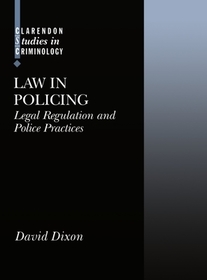
David Dixon poses the questions: how do law and policing relate? and can police practices be significantly changed by means of legal regulation? In examining these questions, this book deals with issues which are at the heart of contemporary debates about policing. It contains empirical research from England and Australia in the context of the international policing literature, arguing that studies of policing need to be connected with debates and developments elsewhere.
MoreLong description:
The book poses the questions: how do law and policing relate; and can police practices be significantly changed by means of legal regulation? In examining these questions, this book deals with issues which are at the heart of contemporary debates about policing. It contains empirical research from England and Australia in the context of the international policing literature, arguing that studies of policing need theoretical and comparative development. The structure of the book is as follows. The first chapter provides a detailed critical reading of three theoretical conceptions of law in policing which the author terms legalistic-bureaucratic, culturalist, and structural. Chapter two examines the concept of police powers, using historical material from England and Australia. The way in which empirical work can generate theoretical reconsideration is shown in Chapter three, which considers the ways in which legal regulation of policing may be evaded by obtaining a suspect's 'consent' to policing practices such as search and detention, and considers the implications of this for conceptions of policing. Chapters four and five focus on the key policing practice of custodial interrogation in, respectively, England and Australia. This leads, in Chapter six, to the long controversy about the right of silence (and to its severe restriction in the Criminal Justice and Public Order Act 1994). It concludes with comments about the symbolic nature of the issue, the theoretical implications of the problems encountered in defining and counting instances of suspects using the right to silence, and the possible effects of the 1994 Act. The final chapter discusses how the practices and forms of law and policing intersect, relates law in policing to broader debates about regulation, the rule of law, and techniques of controlling power, and considers the limits and possibilities of using law to direct and control policing.
It provides an excellent grounding in some of the theoretical perspectives on law and policing, while at the same time providing a framework in which to consider the wide range of research on police powers
Table of Contents:
Theories of Law in Policing
Police Powers: Law in the Books and Elsewhere
Policing by Law and Policing by Consent
Detention for Questioning in England and Wales
The Legal (Non)Regulation of Custodial Interrogation in New South Wales
Silent Suspects and Police Questions
Legality, Regulation and Policing

