

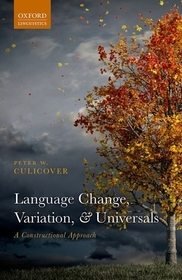
Language Change, Variation, and Universals
- Publisher's listprice GBP 107.50
-
48 536 Ft (46 225 Ft + 5% VAT)
The price is estimated because at the time of ordering we do not know what conversion rates will apply to HUF / product currency when the book arrives. In case HUF is weaker, the price increases slightly, in case HUF is stronger, the price goes lower slightly.
- Discount 10% (cc. 4 853 Ft off)
- Discounted price 43 683 Ft (41 603 Ft + 5% VAT)
Subcribe now and take benefit of a favourable price.
Subscribe
48 536 Ft

Availability
printed on demand
Why don't you give exact delivery time?
Delivery time is estimated on our previous experiences. We give estimations only, because we order from outside Hungary, and the delivery time mainly depends on how quickly the publisher supplies the book. Faster or slower deliveries both happen, but we do our best to supply as quickly as possible.
Product details:
- Publisher OUP Oxford
- Date of Publication 26 August 2021
- ISBN 9780198865391
- Binding Hardback
- No. of pages336 pages
- Size 240x160x20 mm
- Weight 632 g
- Language English 115
Categories
Short description:
This volume explores how human languages become what they are, why they differ from one another in certain ways but not in others, and why they change in the ways that they do. Peter Culicover proposes that language change and variation are responses to the pressure to find efficient grammatical solutions to the task of expressing human thought.
MoreLong description:
This volume explores how human languages become what they are, why they differ from one another in certain ways but not in others, and why they change in the ways that they do. Given that language is a universal creation of the human mind, the puzzle is why there are different languages at all: why do we not all speak the same language? Moreover, while there is considerable variation, in some ways grammars do show consistent patterns: why are languages similar in those respects, and why are those particular patterns preferred?
Peter Culicover proposes that the solution to these puzzles is a constructional one. Grammars consist of constructions that carry out the function of expressing universal conceptual structure. While there are in principle many different ways of accomplishing this task, languages are under press to reduce constructional complexity. The result is that there is constructional change in the direction of less complexity, and grammatical patterns emerge that more efficiently reflect conceptual universals. The volume is divided into three parts: the first establishes the theoretical foundations; the second explores variation in argument structure, grammatical functions, and A-bar constructions, drawing on data from a variety of languages including English and Plains Cree; and the third examines constructional change, focusing primarily on Germanic. The study ends with observations and speculations on parameter theory, analogy, the origins of typological patterns, and Greenbergian 'universals'.
Table of Contents:
Part I: Foundations
Overview
Constructions
Universals
Learning, complexity, and competition
Part II: Variation
Argument structure
Grammatical functions
A' constructions
Part III: Change
Constructional change in Germanic
Changes outside of the CCore
Constructional economy and analogy
Recapitulation and prospects

