

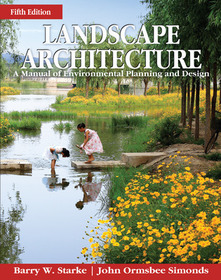
Landscape Architecture, Fifth Edition
A Manual of Environmental Planning and Design
Series: P/L CUSTOM SCORING SURVEY;
- Publisher's listprice GBP 105.99
-
47 854 Ft (45 575 Ft + 5% VAT)
The price is estimated because at the time of ordering we do not know what conversion rates will apply to HUF / product currency when the book arrives. In case HUF is weaker, the price increases slightly, in case HUF is stronger, the price goes lower slightly.
- Discount 10% (cc. 4 785 Ft off)
- Discounted price 43 068 Ft (41 018 Ft + 5% VAT)
Subcribe now and take benefit of a favourable price.
Subscribe
47 854 Ft

Availability
Out of print
Why don't you give exact delivery time?
Delivery time is estimated on our previous experiences. We give estimations only, because we order from outside Hungary, and the delivery time mainly depends on how quickly the publisher supplies the book. Faster or slower deliveries both happen, but we do our best to supply as quickly as possible.
Product details:
- Edition number 5
- Publisher McGraw Hill
- Date of Publication 16 April 2013
- ISBN 9780071797658
- Binding Hardback
- No. of pages432 pages
- Size 292x228x30 mm
- Weight 1665 g
- Language English 0
Categories
Short description:
The classic guide to the theory, application and practice of landscape architecture-updated to include content on sustainable planning, design, and management, plus new color photographs.
MoreLong description:
Publisher's Note: Products purchased from Third Party sellers are not guaranteed by the publisher for quality, authenticity, or access to any online entitlements included with the product.
The most comprehensive, current guide to the theoryand practice of landscape architecture
For more than 50 years, this pioneering guide has served as the foremost resource on the principles and practices of landscape architecture. Now, the book has been revised to address the latest developments in the field, providing a comprehensive, current presentation of the profession.
Richly illustrated with more than 400 full-color images, Landscape Architecture, Fifth Edition, explains how to plan and design for the human use of land with the least environmental impact. This updated volume offers new coverage of important topics such as sustainability, climate change, water conservation, land reuse, urban agriculture, stormwater management, low-impactdesign, and much more. This definitive reference:
- Introduces the fundamentals of site and environmental planning
- Describes the planning constraints imposed by the forms, forces, and features of nature and our built environment
- Addresses climate and its design implications
- Discusses site selection and analysis
- Instructs in the planning of workable and well-related use areas
- Describes the volumetric shaping of exterior spaces
- Explores site-structure relationships andorganization
- Applies contemporary thinking in the planning of expressive human habitations and communities
Landscape Architecture, Fifth Edition, preservesthe essential character and timelessness of the original classic while incorporating up-to-date advancements in the profession.
Extensively revised and filled with more than 400 contemporary full-color images, Landscape Architecture, Fifth Edition, remains the quintessential resource on planning for the human use of land in harmony with the environment. The book presents asystematic approach to the creation of more usable, efficient, and attractive outdoor spaces and places. Teaching diagrams, plans, photographs, and graphics--including the works of many of the world's leading landscape architects and firms--are featuredthroughout. This thoroughly modernized classic offers new coverage of:
- Sustainability
- Climate change and global warming
- Water preservation and water rights
- Land reuse and brownfield redevelopment
- GIS mapping
- Invasive species
- Urban agriculture and urban forestry
- Stormwater management
- Low-impact design
- Complete streets
- New Urbanism, Smart Growth, and Traditional Neighborhood Development
Landscape Architecture, Fifth Edition, addresses every aspect of site and environmental planning, design, and implementation, including:
- The most comprehensive, current guide to the theoryand practice of landscape architecture
- The human habitat and sustainability
- Climate
- Water
- Land
- Vegetation
- The visual landscape
- Topography
- Community planning and growth management
- Rational land use planning
- Urban design
- Site planning
- Site spaces
- Circulation
- Structures
- Landscape planting
Publisher's Note: Products purchased from Third Party sellers are not guaranteed by the publisher for quality, authenticity, or access to any online entitlements included with the product.
The most comprehensive, current guide to the theoryand practice of landscape architecture
For more than 50 years, this pioneering guide has served as the foremost resource on the principles and practices of landscape architecture. Now, the book has been revised to address the latest developments in the field, providing a comprehensive, current presentation of the profession.
Richly illustrated with more than 400 full-color images, Landscape Architecture, Fifth Edition, explains how to plan and design for the human use of land with the least environmental impact. This updated volume offers new coverage of important topics such as sustainability, climate change, water conservation, land reuse, urban agriculture, stormwater management, low-impactdesign, and much more. This definitive reference:
- Introduces the fundamentals of site and environmental planning
- Describes the planning constraints imposed by the forms, forces, and features of nature and our built environment
- Addresses climate and its design implications
- Discusses site selection and analysis
- Instructs in the planning of workable and well-related use areas
- Describes the volumetric shaping of exterior spaces
- Explores site-structure relationships andorganization
- Applies contemporary thinking in the planning of expressive human habitations and communities
Landscape Architecture, Fifth Edition, preservesthe essential character and timelessness of the original classic while incorporating up-to-date advancements in the profession.
Extensively revised and filled with more than 400 contemporary full-color images, Landscape Architecture, Fifth Edition, remains the quintessential resource on planning for the human use of land in harmony with the environment. The book presents asystematic approach to the creation of more usable, efficient, and attractive outdoor spaces and places. Teaching diagrams, plans, photographs, and graphics--including the works of many of the world's leading landscape architects and firms--are featuredthroughout. This thoroughly modernized classic offers new coverage of:
- Sustainability
- Climate change and global warming
- Water preservation and water rights
- Land reuse and brownfield redevelopment
- GIS mapping
- Invasive species
- Urban agriculture and urban forestry
- Stormwater management
- Low-impact design
- Complete streets
- New Urbanism, Smart Growth, and Traditional Neighborhood Development
Landscape Architecture, Fifth Edition, addresses every aspect of site and environmental planning, design, and implementation, including:
- The most comprehensive, current guide to the theoryand practice of landscape architecture
- The human habitat and sustainability
- Climate
- Water
- Land
- Vegetation
- The visual landscape
- Topography
- Community planning and growth management
- Rational land use planning
- Urban design
- Site planning
- Site spaces
- Circulation
- Structures
- Landscape planting
Table of Contents:
Prologue
Foreword
Epigraph
The Hunter and the Philosopher
1. THE HUMAN HABITAT AND SUSTAINABILITY
The Human Animal
Nature
The Natural Sciences
The Ecological Basis
Earthscape
Sustainability
2. CLIMATE
Climate and Response
Social Imprint
Accommodation
Microclimatology
Climate Change/Global Warming
3. WATER
Water as a Resource
Natural Systems
Management
Water
-Related Site Design
4. LAND
Human Impact
Land as a Resource
Land Grants
Land Rights
Surveying
Use
Reuse
Topography
Surveys
Supplementary Data
5. VEGETATION
Topsoil Mantle
Plants in Nature
Plant Identification
Plant Culture
Introduced Plantations
Invasive Species
Vanishing Green
Urban Agriculture
Urban Forestry
6. THE VISUAL LANDSCAPE
The View
The Vista
The Axis
The Symmetrical Plan
Asymmetry
Visual Resource Management
Landscape Character
Modification
The Built Environment
7. THE PLANNED ENVIRONMENT
A Conservation Credo
Environmental Issues
8. COMMUNITY PLANNING AND GROWTH MANAGEMENT
The Group Imperative
Problems
Possibilities
New Directions
Growth Management
Scatteration and Urban Sprawl
Restoration
9. THE REGIONAL LANDSCAPE
Interrelationships
Regional Form
Open
-Space Frame
Greenways and Blueways
The Essentials
Regional Planning
Governance
10. URBAN DESIGN
Cityscape
The City Diagram
The Ubiquitous Automobile
People Places
Urban Green, Urban Blue
The New Urbanity
11. SITE PLANNING
Program Development
Site Selection
Site Analysis
Comprehensive Land Planning
The Conceptual Plan
Computer Application
Site Development
Site
-Structure Plan Development
Site
-Structure Unity
Site Systems
12. SITE SPACES
Spaces
The Base Plane
The Overhead Plane
The Verticals
13. CIRCULATION
Motion
Sequence
Pedestrian Movement
The Automobile
Complete Streets
Travel by Rail, Water, and Air
People Movers
14. STRUCTURES
Common Denominators
Composition
Structures in the Landscape
The Defined Open Space
Habitations
Dwelling
-Nature Relationships
Human Needs and Habitat
Residential Components
15. LANDSCAPE PLANTING
Purpose
Process
Guidelines
Advances
Landscape Plantings in Low
-Impact Design
PERSPECTIVE
Disavowal and Quest
Findings
Insights
Evolution and Revolution
The Planned Experience
Retrospective
Project Credits
Quotation Sources
Bibliography
Index
More
