

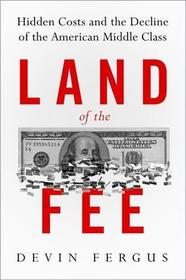
Land of the Fee
Hidden Costs and the Decline of the American Middle Class
- Publisher's listprice GBP 24.49
-
11 057 Ft (10 530 Ft + 5% VAT)
The price is estimated because at the time of ordering we do not know what conversion rates will apply to HUF / product currency when the book arrives. In case HUF is weaker, the price increases slightly, in case HUF is stronger, the price goes lower slightly.
- Discount 10% (cc. 1 106 Ft off)
- Discounted price 9 951 Ft (9 477 Ft + 5% VAT)
Subcribe now and take benefit of a favourable price.
Subscribe
11 057 Ft

Availability
Estimated delivery time: In stock at the publisher, but not at Prospero's office. Delivery time approx. 3-5 weeks.
Not in stock at Prospero.
Why don't you give exact delivery time?
Delivery time is estimated on our previous experiences. We give estimations only, because we order from outside Hungary, and the delivery time mainly depends on how quickly the publisher supplies the book. Faster or slower deliveries both happen, but we do our best to supply as quickly as possible.
Product details:
- Publisher OUP USA
- Date of Publication 13 September 2018
- ISBN 9780199970162
- Binding Hardback
- No. of pages260 pages
- Size 163x236x27 mm
- Weight 485 g
- Language English 0
Categories
Short description:
Land of the Fee exposes the barely visible system of fees that pervades everyday life in America, and explores how this system has shaped wealth inequality in contemporary America.
MoreLong description:
Politicians, economists, and the media have put forth no shortage of explanations for the mounting problem of wealth inequality - a loss of working class jobs, a rise in finance-driven speculative capitalism, and a surge of tax policy decisions that benefit the ultra-rich, among others. While these arguments focus on the macro problems that contribute to growing inequality, they overlook one innocuous but substantial contributor to the widening divide: the explosion of fees accompanying virtually every transaction that people make.
As Devin Fergus shows in Land of the Fee, these perfectly legal fees are buried deep within the verbose agreements between vendors and consumers - agreements that few people fully read or comprehend. The end effect, Fergus argues, is a massive transfer of wealth from the many to the few: large banking corporations, airlines, corporate hotel chains, and other entities of vast wealth. Fergus traces the fee system from its origins in the deregulatory wave of the late 1970s to the present, placing the development within the larger context of escalating income inequality. He organizes the book around four of the basics of existence: housing, work, transportation, and schooling. In each category, industry lobbyists successfully influenced legislatures into transforming the law until surreptitious fees became the norm.
The average consumer is now subject to a dizzying array of charges in areas like mortgage contracts, banking transactions, auto insurance rates, college payments, and payday loans. The fees that accompany these transactions are not subject to usury laws and have effectively redistributed wealth from the lower and middle classes to ultra-wealthy corporations and the individuals at their pinnacles. By exposing this predatory and nearly invisible system of fees, Land of the Fee will reshape our understanding of wealth inequality in America.
This book is an outstanding primary text and faculty resource for upper-division and graduate classes in public and taxation policy and financial markets, regulation, and ethics
Table of Contents:
Table of Contents
Introduction
Section One: Home
Section Two: School
Section Three: Work
Section Four: Transportation
Section Five: Implications Abroad
Conclusion

