

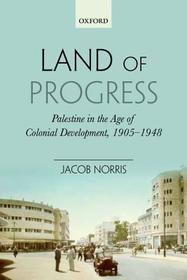
Land of Progress
Palestine in the Age of Colonial Development, 1905-1948
- Publisher's listprice GBP 140.00
-
63 210 Ft (60 200 Ft + 5% VAT)
The price is estimated because at the time of ordering we do not know what conversion rates will apply to HUF / product currency when the book arrives. In case HUF is weaker, the price increases slightly, in case HUF is stronger, the price goes lower slightly.
- Discount 10% (cc. 6 321 Ft off)
- Discounted price 56 889 Ft (54 180 Ft + 5% VAT)
Subcribe now and take benefit of a favourable price.
Subscribe
63 210 Ft

Availability
printed on demand
Why don't you give exact delivery time?
Delivery time is estimated on our previous experiences. We give estimations only, because we order from outside Hungary, and the delivery time mainly depends on how quickly the publisher supplies the book. Faster or slower deliveries both happen, but we do our best to supply as quickly as possible.
Product details:
- Publisher OUP Oxford
- Date of Publication 11 April 2013
- ISBN 9780199669363
- Binding Hardback
- No. of pages256 pages
- Size 241x162x22 mm
- Weight 536 g
- Language English
- Illustrations Two maps and eight images 0
Categories
Short description:
A study of Palestine in the early twentieth century that takes a step back from the intricacies of the Arab-Zionist conflict, focusing instead on the country's position within the broader history of empire and anti-colonial resistance.
MoreLong description:
Histories of Palestine in the pre-1948 period usually assume the emergent Arab-Zionist conflict to be the central axis around which all change revolves. In Land of Progress Jacob Norris suggests an alternative historical vocabulary is needed to broaden our understanding of the region's recent past. In particular, for the architects of empire and their agents on the ground, Palestine was conceived primarily within a developmental discourse that pervaded colonial practice from the turn of the twentieth century onwards. A far cry from the post-World War II focus on raising living standards, colonial development in the early twentieth century was more interested in infrastructure and the exploitation of natural resources.
Land of Progress charts this process at work across both the Ottoman and British periods in Palestine, focusing on two of the most salient but understudied sites of development anywhere in the colonial world: the Dead Sea and Haifa. Weaving the experiences of local individuals into a wider narrative of imperial expansion and anti-colonial resistance, Norris demonstrates the widespread excitement Palestine generated among those who saw themselves at the vanguard of progress and modernisation, whether they were Ottoman or British, Arab or Jewish. Against this backdrop, Norris traces the gradual erosion during the mandate period of the mixed style of development that had prevailed under the Ottoman Empire, as the new British regime viewed Zionism as the sole motor of modernisation. As a result, the book's latter stages relate the extent to which colonial development became a central issue of contestation in the struggle for Palestine that unfolded in the 1930s and 40s.
a must-read book that may or may not convince the reader but will certainly instigate a healthy debate.
Table of Contents:
Introduction
Ottoman colonial development: Palestine and the Eastern Mediterranean
Agents of development: Jews, Arabs, and the middlemen of empire
The 'city of the future': Haifa, capital of British Palestine
Palestine's 'undeveloped estate': the exploitation of the Dead Sea
Toxic waters: contesting British development at Haifa and the Dead Sea
Conclusions: the legacies of development
Bibliography
Index

