

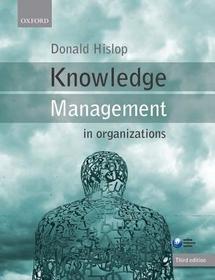
Knowledge Management in Organizations
A Critical Introduction
- Publisher's listprice GBP 42.99
-
19 409 Ft (18 485 Ft + 5% VAT)
The price is estimated because at the time of ordering we do not know what conversion rates will apply to HUF / product currency when the book arrives. In case HUF is weaker, the price increases slightly, in case HUF is stronger, the price goes lower slightly.
- Discount 10% (cc. 1 941 Ft off)
- Discounted price 17 468 Ft (16 637 Ft + 5% VAT)
Subcribe now and take benefit of a favourable price.
Subscribe
19 409 Ft

Availability
Out of print
Why don't you give exact delivery time?
Delivery time is estimated on our previous experiences. We give estimations only, because we order from outside Hungary, and the delivery time mainly depends on how quickly the publisher supplies the book. Faster or slower deliveries both happen, but we do our best to supply as quickly as possible.
Product details:
- Edition number 3
- Publisher OUP Oxford
- Date of Publication 31 January 2013
- ISBN 9780199691937
- Binding Paperback
- No. of pages304 pages
- Size 245x190x14 mm
- Weight 584 g
- Language English 0
Categories
Short description:
Knowledge Management in Organizations introduces the reader to the concept of organizational knowledge before examining how, and whether, knowledge can be managed. Adopting a multidisiplinary perspective, the third edition presents a critical perspective of knowledge managament, encompassing issues of strategy, structure, systems and HRM.
MoreLong description:
Building on the success of the second edition, the third edition of Knowledge Management in Organizations presents a critical introduction to the subject. Adopting a multidisciplinary perspective, encompassing issues of strategy, structure, systems and human resource management, the text introduces the reader to the concept of knowledge before examining how, and whether, knowledge can be managed within the organizations in which we work. The third edition
features a new section on intellectual capital accounting, increased discussion on the use of social networking technologies and significant updates to chapters on Knowledge Creation, Facilitating Knowledge Management via Culture Management, and Leadership, HRM and Knowledge Management.
This accessible and engaging text provides a comprehensive introduction to the subject, and incorporates a wealth of in-text learning features and examples in every chapter. International case studies throughout the text, which have been fully updated to reflect changes in the economic and political landscape since the previous edition, as well as new and emerging trends in the field, further illustrate knowledge management theory in a real-world business context.
The text is supported by a fully integrated Online Resource Centre, offering additional resources for students and registered lecturers:
For students:
Additional case studies
Web links
For registered lecturers:
Diagrams from the textbook
Examples of exam questions
Examples of essay/coursework questions
Suggestions for classroom activities to facilitate discussion around the themes addressed in the book
Table of Contents:
Introduction: The Contemporary Importance of Knowledge and Knowledge Management
SECTION 1: EPISTEMOLOGIES OF KNOWLEDGE IN THE KNOWLEDGE MANAGEMENT LITERATURE
The Objectivist Perspective on Knowledge
The Practice-Based Perspective on Knowledge
SECTION 2: AN INTRODUCTION TO KEY CONCEPTS
What is Knowledge Management?
Knowledge Intensive Firms and Knowledge Workers
Learning and Knowledge Management
SECTION 3: KNOWLEDGE CREATION AND ORGANIZATIONAL LOSS
Nonaka and Knowledge Creation Theory
Unlearning and the Deliberate Loss of Knowledge
SECTION 4: SOCIO-CULTURAL ISSUES RELATED TO MANAGING AND SHARING KNOWLEDGE
The Influence of Socio-Cultural Factors in Motivating Workers to Participate in Knowledge Management Initiatives
Communities of Practice
Cross Community, Boundary Spanning Knowledge Processes
Power, Politics, Conflict, and Knowledge Processes
Information and Communication Technologies and Knowledge Management
Facilitating Knowledge Management via the use of Human Resource Management Practices
Leadership, Organizational Culture Management and Knowledge Management
Reflections on the topic of Knowledge Management

