

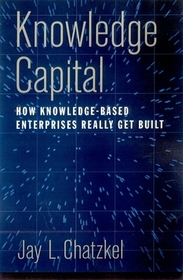
Knowledge Capital
How Knowledge-Based Enterprises Really Get Built
- Publisher's listprice GBP 88.00
-
39 732 Ft (37 840 Ft + 5% VAT)
The price is estimated because at the time of ordering we do not know what conversion rates will apply to HUF / product currency when the book arrives. In case HUF is weaker, the price increases slightly, in case HUF is stronger, the price goes lower slightly.
- Discount 10% (cc. 3 973 Ft off)
- Discounted price 35 759 Ft (34 056 Ft + 5% VAT)
Subcribe now and take benefit of a favourable price.
Subscribe
39 732 Ft

Availability
printed on demand
Why don't you give exact delivery time?
Delivery time is estimated on our previous experiences. We give estimations only, because we order from outside Hungary, and the delivery time mainly depends on how quickly the publisher supplies the book. Faster or slower deliveries both happen, but we do our best to supply as quickly as possible.
Product details:
- Publisher OUP USA
- Date of Publication 14 August 2003
- ISBN 9780195161144
- Binding Hardback
- No. of pages432 pages
- Size 245x160x29 mm
- Weight 730 g
- Language English
- Illustrations numerous line drawings and 2 tables 0
Categories
Short description:
Knowledge Capital: How Knowledge-Based Enterprises Really Get Built is an integrated, structured set of conversations with thought leaders and key practitioners in the fields of intellectual capital and knowledge management, who examine-in the form of conversations-the steps necessary for creating and implementing the various dimensions of a knowledge-based enterprise. These are the dimensions that need to be effectively addressed for the organization to successfully make the transition from an activity-based organization to a truly knowledge-based enterprise. The conversations that make up Knowledge Capital are not studies of theory separated from practice or practice without a strong theoretical base. Rather, they are the stories of how knowledge-based enterprises really get built, in the words of the people who built them. While every contributor begins from his or her own unique perspective and background, each moves toward a convergent understanding of the core elements, perspectives, and practices involved. These systemic conversations provide a body of knowledge and experience on how to craft and implement strategies, as well as how values, learning, performance, relationships, innovation, and change play in the development of usable knowledge environment. These explorations, together, lead to a mapping of what are quickly becoming the foundations of the next stage of the field. Knowledge Capital gives the reader a readily accessible collection of insights and experiences essential for the new era in intellectual capital and knowledge management.
MoreLong description:
Knowledge Capital: How Knowledge-Based Enterprises Really Get Built is an integrated, structured set of conversations with thought leaders and key practitioners in the fields of intellectual capital and knowledge management, who examine-in the form of conversations-the steps necessary for creating and implementing the various dimensions of a knowledge-based enterprise. These are the dimensions that need to be effectively addressed for the organization to successfully make the transition from an activity-based organization to a truly knowledge-based enterprise. The conversations that make up Knowledge Capital are not studies of theory separated from practice or practice without a strong theoretical base. Rather, they are the stories of how knowledge-based enterprises really get built, in the words of the people who built them. While every contributor begins from his or her own unique perspective and background, each moves toward a convergent understanding of the core elements, perspectives, and practices involved. These systemic conversations provide a body of knowledge and experience on how to craft and implement strategies, as well as the how values, learning, performance, relationships, innovation, and change play in the development of usable knowledge environment. These explorations, together, lead to a mapping of what are quickly becoming the foundations of the next stage of the field. Knowledge Capital gives the reader a readily accessible collection of insights and experiences essential for the new era in intellectual capital and knowledge management.
MoreTable of Contents:
Introduction: Why Knowledge Capital?
KNOWLEDGE Cluster I: Starting Points
Operating as a Knowledge System
The Knowledge Business
The Knowledge Movement Emerges from Its Infancy
KNOWLEDGE Cluster II: Strategic Issues
Recipes for Knowledge-Based Value Creation
The Intelligent Organization
Understanding the Enterprise as a System
KNOWLEDGE Cluster III: Human Capital, Values, and Learning
Human Capital Is the Only Active Asset
People Are the Owners and Investors of Human Capital
Shared Values--The Prerequisite for Knowledge Sharing and Creation
Learning in the Knowledge Era
KNOWLEDGE Cluster IV: Drivers and Accounting for Intangible Wealth
Value Drivers for Intangibles
A Level Playing Field for Intangibles
KNOWLEDGE Cluster V: Bringing It All Together in Practice
Creating and Implementing a Knowledge Strategy
Knowledge Management Is about Change
Finding "the Hook"
The Springboard Story
The Knowledge-Centric Organization
EPILOGUE: Convergence--Toward the Next Stage
TEN QUESTIONS: Leading Your Organization into Becoming a Knowledge-Based Enterprise
RESOURCES: Books for Building a Knowledge-Based Enterprise
INDEX

