

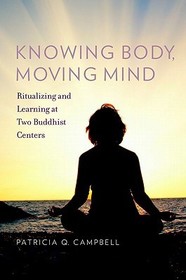
Knowing Body, Moving Mind
Ritualizing and Learning at Two Buddhist Centers
Series: Oxford Ritual Studies Series;
- Publisher's listprice GBP 25.99
-
11 734 Ft (11 175 Ft + 5% VAT)
The price is estimated because at the time of ordering we do not know what conversion rates will apply to HUF / product currency when the book arrives. In case HUF is weaker, the price increases slightly, in case HUF is stronger, the price goes lower slightly.
- Discount 10% (cc. 1 173 Ft off)
- Discounted price 10 560 Ft (10 058 Ft + 5% VAT)
Subcribe now and take benefit of a favourable price.
Subscribe
11 734 Ft

Availability
Out of print
Why don't you give exact delivery time?
Delivery time is estimated on our previous experiences. We give estimations only, because we order from outside Hungary, and the delivery time mainly depends on how quickly the publisher supplies the book. Faster or slower deliveries both happen, but we do our best to supply as quickly as possible.
Product details:
- Publisher Oxford University Press
- Date of Publication 13 October 2011
- ISBN 9780199793815
- Binding Paperback
- No. of pages250 pages
- Size 229x145x19 mm
- Weight 364 g
- Language English 0
Categories
Short description:
Knowing Body, Moving Mind explores ritualizing and learning in meditation classes at two Buddhist centers in Toronto. Based on interviews with students and teachers, it explores the ways formal Buddhist practices generate learning; discovering that body and mind together gain new skills and understanding by way of embodied, gestural rites.
MoreLong description:
Knowing Body, Moving Mind investigates ritualizing and learning in introductory meditation classes at two Buddhist centers in Toronto, Canada. The centers, Friends of the Heart and Chandrakirti, are led and attended by Western (sometimes called "convert') Buddhists: that is, people from non-Buddhist familial and cultural backgrounds. Inspired by theories that suggest that rituals impart new knowledge or understanding, Patricia Campbell examines how
introductory meditation students learn through formal Buddhist practice. Along the way, she also explores practitioners' reasons for enrolling in meditation classes, their interests in Buddhism, and their responses to formal Buddhist practices and to ritual in general.
Based on ethnographic interviews and participant-observation fieldwork, the text follows interview participants' reflections on what they learned in meditation classes and through personal practice, and what roles meditation and other ritual practices played in that learning. Participants' learning experiences are illuminated by an influential learning theory called Bloom's Taxonomy, while the rites and practices taught and performed at the centers are explored using performance theory, a
method which focuses on the performative elements of ritual's postures and gestures. But the study expands the performance framework as well, by demonstrating that performative ritualizing includes the concentration techniques that take place in a meditator's mind.
Such techniques are received as traditional mental acts or behaviors that are standardized, repetitively performed, and variously regarded as special, elevated, spiritual or religious. Having established a link between mental and physical forms of ritualizing, the study then demonstrates that the repetitive mental techniques of meditation practice train the mind to develop new skills in the same way that physical postures and gestures train the body. The mind is thus experienced as both
embodied and gestural, and the whole of the body as socially and ritually informed.
Table of Contents:
Introduction
Chapter One: Friends of the Heart and Chandrakirti Centre: Meditation in Toronto
Friends of the Heart
Chandrakirti Centre
Outreach
Chapter Two: Discovery Stories
Why Take a Meditation Class?
Chapter Three: Meditation Classes, Rites, and Ritual
Rites of Entry
Opening Prayer
Meditation
Talks or Lectures
Group Discussion and Socializing
Closing Rites
Ritual and Introductory Meditation Classes
Ritualization and Ritualizing
Performance Theory and Restoration of Behavior
Conclusion
Chapter Four: Beyond Knowledge
Bloom's Taxonomy
Cognitive Learning
Affective Learning
Psychomotor Learning
A Fourth Domain?
"Practice" as Changing Behavior
Conclusion
Chapter Five: The Ritualizing Body-Mind
Ritualizing and Decorum
Prostrations
Learning, Experimentation and Invariance
Cognitive Learning and Ritualizing
Ritualizing and Meditation
Meditation and Embodied Knowing
Conclusion
Chapter Six: Learning is Change
Newcomers, Learning and Change
Teacher's Objectives
Conclusion
Appendix: Student Interview Participants by Name
Notes
Bibliography

