

- Publisher's listprice GBP 64.00
-
30 576 Ft (29 120 Ft + 5% VAT)
The price is estimated because at the time of ordering we do not know what conversion rates will apply to HUF / product currency when the book arrives. In case HUF is weaker, the price increases slightly, in case HUF is stronger, the price goes lower slightly.
- Discount 10% (cc. 3 058 Ft off)
- Discounted price 27 518 Ft (26 208 Ft + 5% VAT)
Subcribe now and take benefit of a favourable price.
Subscribe
30 576 Ft

Availability
Not yet published.
Why don't you give exact delivery time?
Delivery time is estimated on our previous experiences. We give estimations only, because we order from outside Hungary, and the delivery time mainly depends on how quickly the publisher supplies the book. Faster or slower deliveries both happen, but we do our best to supply as quickly as possible.
Product details:
- Publisher OUP USA
- Date of Publication 13 March 2026
- ISBN 9780190089139
- Binding Hardback
- No. of pages320 pages
- Size 235x156 mm
- Weight 3 g
- Language English 700
Categories
Short description:
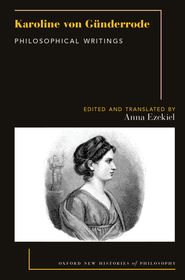
Philosophical Fragments is a volume of translations of short pieces by the German philosopher and poet Karoline von Günderrode (1780-1806), with accompanying introductions. Günderrode was a nuanced thinker with a gift for using literary forms to engage readers with philosophical ideas. Her work provides original responses to the same questions that concerned male philosophers of her time, especially those in the German Idealist and Early German Romantic traditions: What is it to be an individual human being? What is the nature of the universe? Do we have free will, or are our actions determined by operations beyond our control? What can we know about the world, and how? What happens to us after we die? How should we behave while we are alive? What forms of social and political life should we foster?
MoreLong description:
At the start of the nineteenth century, Karoline von Günderrode burst onto the German intellectual scene with multi-genre collections of philosophical literature that were read by Goethe, Clemens Brentano, and other famous writers and academics. But Günderrode's philosophical insights were largely ignored or adopted without credit and in 1806 she died by suicide, leaving behind a small but powerful set of reflections on the nature of the self, friendship, life after death, human-nature relations, social progress, epistemology, religion, ethics, and many other topics. Long celebrated as an embodiment of tragic Romantic poetry, Günderrode has recently been rediscovered as the author of an original and exciting philosophy.
Günderrode was a nuanced thinker with a gift for using literary forms to engage readers with philosophical ideas. This volume makes many of Günderrode's most significant published and unpublished works, along with excerpts from her letters and notes on philosophical topics, available for the first time in English. The short introductions accompanying each text explicate the ideas embedded in Günderrode's writing, connecting them to intellectual debates of the day and to relevant work by better-known philosophers including Kant, Plato, Schelling, Herder, Schleiermacher, Hemsterhuis, Schlegel, and Novalis. The general introduction provides a more comprehensive orientation to Günderrode's philosophy, considering her metaphysics, epistemology, social and political thought, ethics, aesthetics, and reflections on gender, death, friendship, and human identity.
Table of Contents:
Introduction
Part 1. Works
Idea of the Earth
Letters of Two Friends
The Manes
The Malabarian Widows
"An Apocalyptic Fragment" and "A Dream"
The Wanderer's Descent
The Adept
The Frank in Egypt
Immortalita
Story of a Brahmin
Fragments on Ethics and Aesthetics
Fragments on Music
The Aeronaut
Once I Lived Sweet Life
Mora
Udohla
Part 2. Notebooks
Introduction to Günderrode's Notebooks
Notes on Philosophy of Nature
Notes on Chemistry
Notes on the Early German Romantics
Notes on Schleiermacher
Notes on Hemsterhuis
Miscellaneous Notes
Part 3. Letters
Günderrode's Letters
Appendix: Sources for the Translations

