

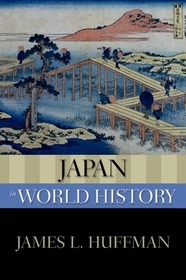
Japan in World History
Series: New Oxford World History;
- Publisher's listprice GBP 28.99
-
13 088 Ft (12 465 Ft + 5% VAT)
The price is estimated because at the time of ordering we do not know what conversion rates will apply to HUF / product currency when the book arrives. In case HUF is weaker, the price increases slightly, in case HUF is stronger, the price goes lower slightly.
- Discount 10% (cc. 1 309 Ft off)
- Discounted price 11 779 Ft (11 219 Ft + 5% VAT)
Subcribe now and take benefit of a favourable price.
Subscribe
13 088 Ft

Availability
printed on demand
Why don't you give exact delivery time?
Delivery time is estimated on our previous experiences. We give estimations only, because we order from outside Hungary, and the delivery time mainly depends on how quickly the publisher supplies the book. Faster or slower deliveries both happen, but we do our best to supply as quickly as possible.
Product details:
- Publisher OUP USA
- Date of Publication 11 February 2010
- ISBN 9780195368086
- Binding Paperback
- No. of pages176 pages
- Size 231x152x12 mm
- Weight 295 g
- Language English
- Illustrations 22 black and white halftones, 6 line illustrations 0
Categories
Short description:
Japan in World History addresses the entire scope of Japanese history, beginning with Japan's prehistoric culture and ending with a look at Japan in the world today. The majority of large-scale history books on Japan, by contrast, focus on the modern era, and those that cover the entire scope of its history are not written for general readers and do not focus on Japan's international engagement. This work stands apart for its narration of traditional historical developments through the perspective of interactions and comparisons with the broader world.
MoreLong description:
Here is a page-turning, compact history of Japan from earliest times to the present, with a focus on its often tempestuous, often creative relationships with other countries. The book ranges from Japan's prehistoric interactions with Korea and China, to the Western challenge of the late 1500s, the partial isolation under the Tokugawa family (1600-1868), and the tumultuous interactions of more recent times, when Japan modernized ferociously, turned imperialist, lost a world war, then became the world's second largest economy--and its greatest foreign aid donor. Writing in a lively fashion, Huffman makes rich use of primary documents, illustrating events with comments by the people who lived through them: tellers of ancient myths, court women who dominated the early literary world, cynical priests who damned medieval materialism, travelers who marveled at "indecent" Western ballroom dancers in the mid-1800s, and the emperor who justified Pearl Harbor. Without ignoring standard political and military events, the book illuminates economic, social, and cultural factors; it also examines issues of gender as well as the roles of commoners, samurai, business leaders, novelists, and priests.
Huffman manages to convey to the general reader a concise and clear sense of the sweep of Japanese history, from earliest recorded history to the turn of the millennium...James Huffman's account of Japanese history will prove eminently useful in surveys of Japanese history, especially if paired with his recently published primary source reader entitled Modern Japan: A History in Documents, also published through Oxford University Press.
Table of Contents:
Introduction
Japan's Emergence (to c. 600 c.e.)
The Aristocratic Era (600-1160)
Years of War (1160-1550)
Peace and Relative Isolation (1550-1868)
Entering the Modern World (1868-1912)
At War with the World (1912-1945)
Japan in the Postwar World (1945- )
Chonology
Notes
Further Reading
Web Sites
Index

