

- Publisher's listprice GBP 9.99
-
4 510 Ft (4 295 Ft + 5% VAT)
The price is estimated because at the time of ordering we do not know what conversion rates will apply to HUF / product currency when the book arrives. In case HUF is weaker, the price increases slightly, in case HUF is stronger, the price goes lower slightly.
- Discount 10% (cc. 451 Ft off)
- Discounted price 4 059 Ft (3 866 Ft + 5% VAT)
Subcribe now and take benefit of a favourable price.
Subscribe
4 510 Ft

Availability
Not yet published.
Why don't you give exact delivery time?
Delivery time is estimated on our previous experiences. We give estimations only, because we order from outside Hungary, and the delivery time mainly depends on how quickly the publisher supplies the book. Faster or slower deliveries both happen, but we do our best to supply as quickly as possible.
Product details:
- Publisher OUP Oxford
- Date of Publication 24 December 2026
- ISBN 9780198823537
- Binding Paperback
- No. of pages160 pages
- Size 174x111 mm
- Language English
- Illustrations 8-10 black and white illustrations 0
Categories
Short description:
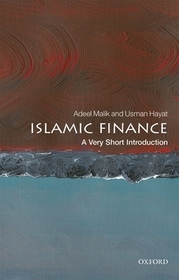
With a full scope of financial services, ranging from banking and capital markets to insurance and microfinance, Islamic finance has now become the most prominent form of faith-based finance in the world. This book sheds light on its core principles and practices, and considers its performance and potential compared with conventional finance.
MoreLong description:
Very Short Introductions: Brilliant, Sharp, Inspiring
With a full scope of financial services, ranging from banking and capital markets to insurance and microfinance, Islamic finance has now become the most prominent form of faith-based finance in the world. After a period of double digit growth, the global assets of Islamic finance reached USD 2 trillion in 2015. Today more than 300 institutions are engaged in Islamic finance across the world. Despite this success, the field remains poorly understood.
Confusion can arise from media condemnation of Islamic extremism and, at the same time, praise for Islamic finance even if both claim allegiance to the same religion. Compounding this confusion is the academic narrative that treats finance as a purely secular subject that has little to do with the ethos and rules of a religion. The complex terminologies, which are mostly rooted in Islam's legal injunctions and historical practices, can render the field even more incomprehensible. This Very Short Introduction demystifies Islamic finance by shedding light on its core principles and practices. Adeel Malik and Usman Hayat cover the main debates surrounding Islamic finance's performance and potential, comparing and contrasting Islamic financial instruments with those of conventional finance, and building connections between Islamic finance and other ethical traditions in finance.
ABOUT THE SERIES: The Very Short Introductions series from Oxford University Press contains hundreds of titles in almost every subject area. These pocket-sized books are the perfect way to get ahead in a new subject quickly. Our expert authors combine facts, analysis, perspective, new ideas, and enthusiasm to make interesting and challenging topics highly readable.
Table of Contents:
Acknowledgements
List of illustrations
What is Islamic finance?
Instruments of Islamic finance
Form versus substance
Political economy of Islamic finance
Islamic finance, social justice and development
Further reading
Index

